Cultivation of Gray Mangroves Avicennia marina (Forssk) Vierh. in the Iraqi Coast
Keywords:
Iraqi Coast, Avicennia marina, Mangroves, Khor Al-Zubair oil port, Al-Faw Grand port.Abstract
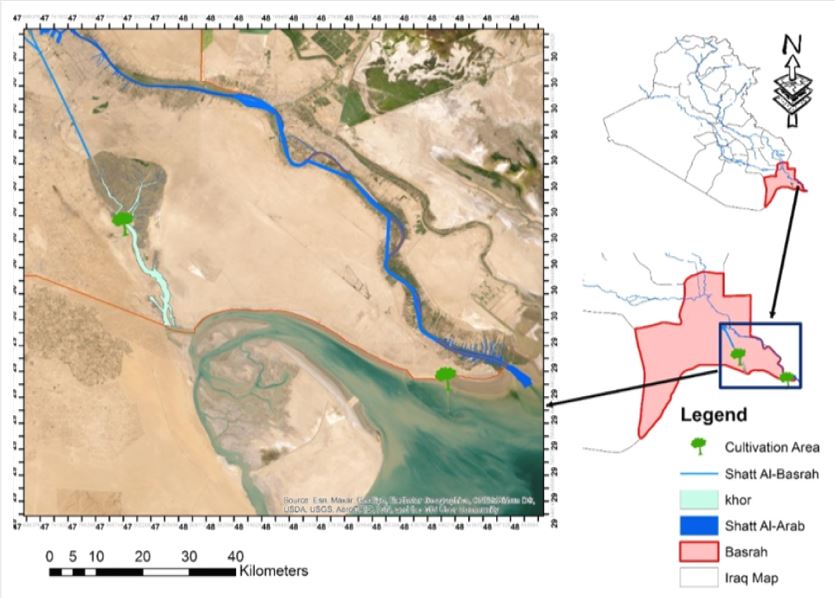
The ecosystems of the Iraqi marine coasts are notoriously poor in vegetation and highly vulnerable to coastal erosion. The current study aims at finding out the possibility of cultivating the Iraqi coasts with mangrove Avicennia marina. Two sites were chosen to conduct the experiment, the first in the Khor Al-Zubair oil port, and the second in the Al-Faw Grand port. The experiment was carried out by planting 50 seedlings in each site, in order to study the possibility of acclimatization of gray mangrove plants in these environments. Experimental measurements of vegetative growth indicators, total chlorophyll content, and survival rates were taken during the study period. The results demonstrated a normal growth of plants in the Khor Al-Zubair oil port site, as it recorded an average height of seedlings amounted to 93.8 cm during the study period at a daily rate of 0.256 cm.day-1. total Chlorophyll content increased from 43.68-52.10 µg.cm-2, while achieving survival rates of 78% at the end of the experiment. Compared to the site of the Al-Faw Grand port, it achieved medium vegetative growth during the first six months of the experiment, after that the plants began to deteriorate, and thus to the destruction of all seedlings after 12 months of the experiment's life. This failure is primarily attributed to high wave energy /extreme soil compaction /open sea exposure. These findings suggest that sheltered coastal environments like Khor Al-Zubair are viable candidates for mangrove restoration in Iraq, whereas open coastlines require prior artificial wave-breaker protection.
Metrics
References
Al-Habshi, A., Youssef, T., Aizpuru, M., and Blasco, F. (2007). New mangrove ecosystem data along the UAE coast using remote sensing. Aquatic Ecosystem Health and Management, 10(3): 309-319. https://doi.org/ 10.1080/14634980701512525.
Ali, M.H., Al-Mudaffar, N., Mohammed, H.H., Helmuth, B., and Dwyer, A. (2021). Winners and losers: Post conflict biodiversity in the stressed ecosystem of Khor Al-Zubair, Iraq. Pakistan Journal of Marine Sciences, 30(2): 76-95. URI: hdl.handle.net/1834/42004.
Al-Mahmood, H.K. (2006). The Properties of Iraqi Coast (Geographical Study). (Doctoral dissertation, Collage of Arts – University of Basrah).
Al-Mahmood, H.K., Al-Manssory, F.Y., Al- Mosawi, W.M., and Shbar H.A. (2018). Developing of the Iraqi Coastal Environment in the Northern-West of Arabian Gulf. Journal of Geographical Research, 28 (2): Pages 115-140. https://doi.org/ 10.36328/0833-000-028-017.
Al-Mayah, A.A., Al-Edany, T.Y., and Al-Asadi, W.M. (2016). Ecology and Flora of Basrah. Jeekor for printing, publishing and distribution. Lebanon - Beirut. 686 pages.
Al-Mukhtar, D.A., Al-Ramadhan, B.M., and Al-Sayab, H. (1992). One dimensional numerical model for tidal movement in Khowr Al-Zubair. Mahasagar, 25(2): 65-71.
Alongi, D.M. (2008). Mangrove forests: resilience, protection from Tsunamis, and responses to global climate change. Estuarine, coastal and shelf science, 76(1): 1-13. https://doi.org/ 10.1016/j.ecss.2007.08.024.
Alongi, D.M. (2009). The Energetics of Mangrove Forests. Springer Science and Business Media. https://doi.org/10.1007/978-1-4020-4271-3.
Al-Ramadhan, B.M. (1988). Residual fluxes of water in an estuarine lagoon. Estuarine, Coastal and Shelf Science. 26(3): 319-330. https://doi.org/10.1016/0272-7714(88)90068-6.
Al-Taei, S.A., Subber, A.R., and Al-Imarah, F.J. (2012). The application of two-dimensional model on oil spill movement in Khor AL Zubair, North west, Arabian Gulf. Adv. Appl. Sci. Res, 3(4): 1963-1977.
Balke, T., Bouma, T.J., Horstman, E.M., Webb, E.L., Erftemeijer, P.L., and Herman, P.M. (2011). Windows of opportunity: thresholds to mangrove seedling establishment on tidal flats. Marine Ecology Progress Series, 440, 1-9. https://doi.org/10.3354/meps09364.
Bhat, N.R., Suleiman, M.K., and Shahid, S.A. (2004). Mangrove, Avicennia marina, establishment and growth under the arid climate of Kuwait. Arid Land Research and Management, 18(2): 127-139. https://doi.org/10.1080/15324980490280799.
Campbell, M.K., Farrell, S.O., and McDougal, O.M. (2016). Biochemistry. Cengage Learning.
Clarke, P.J., and Allaway, W.G. (1993). The regeneration niche of the grey mangrove (Avicennia marina): effects of salinity, light and sediment factors on establishment, growth and survival in the field. Oecologia, 93(4): 548-556. https://doi.org/10.1007/BF00328964.
Clough, B. (1998). Mangrove forest productivity and biomass accumulation in Hinchinbrook Channel, Australia. Mangroves and Salt Marshes, 2(4): 191-198. https://doi.org/10.1023/A:1009979610871.
Dakheel, A.A., Al-Aboodi, A.H., and Abbas, S.A. (2022). Investigation for hydrodynamic processes of water in Khour Al-Zubair Port using hydrodynamic model. Materials Today: Proceedings, 61, 1073-1082.
Day Jr, J.W., Kemp, W.M., Yáñez-Arancibia, A., Crump, B.C. (Eds.). (2012). Estuarine Ecology. John Wiley and Sons.
Duke, N.C. (1992). Mangrove Floristics and Biogeography. In: Tropical Mangrove Ecosystems. Coastal and Estuarine Studies Series, Robertson, A.I. and D.M. Alongi (Eds.), Washington, D.C: American Geophysical Union, pp: 63-100. https://doi.org/10.1029/CE041p0063.
Embabi, N.S. (1993). Environmental Aspects of Geographical Distribution of Mangrove in the United Arab Emirates. In Towards the Rational Use of High Salinity Tolerant Plants (pp. 45-58). Springer, Dordrecht. https://doi.org/10.1007/978-94-011-1858-3_5.
Erftemeijer, P.L., Agastian, T., Yamamoto, H., Cambridge, M.L., Hoekstra, R., Toms, G., and Ito, S. (2020). Mangrove planting on dredged material: three decades of nature-based coastal defence along a causeway in the Arabian Gulf. Marine and Freshwater Research, 71(9): 1062-1072. https://doi.org/10.1071/MF19289.
Erftemeijer, P.L., Wylie, N., and Hooper, G.J. (2017). Successful mangrove establishment along an artificially created tidal creek at Port Hedland, Western Australia. Marine and Freshwater Research, 69(1): 134-143. https://doi.org/10.1071/MF17139.
Hubbard, P.A. (1994). Seedling recruitment of the mangrove Avicennia marina in the Port Hedland area. B.Sc. (Hons) Thesis, School of Environmental Sciences, Murdoch University, Murdoch, WA, Australia.
Hutchings P., and Saenger P. (1987). Ecology of Mangroves. St Lucia, University of Queensland Press. pp.xxii + 388pp.
LeProvost Dames and Moore (1997). Cargill Salt – environmental management programme. Mangrove monitoring programme and rehabilitation plan – 1996 annual report. Report number R630, LDM, Perth, WA, Australia.
Lewis III, R.R. (2005). Ecological engineering for successful management and restoration of mangrove forests. Ecological engineering, 24(4): 403-418. https://doi.org/10.1016/j.ecoleng.2004.10.003.
Li, S., Meng, X., Ge, Z., and Zhang, L. (2015). Vulnerability assessment of the coastal mangrove ecosystems in Guangxi, China, to sea-level rise. Regional environmental change, 15(2): 265-275. https://doi.org/10.1007/s10113-014-0639-3.
Lovelock, C. E., and Feller, I.C. (2003). Photosynthetic performance and resource utilization of two mangrove species coexisting in a hypersaline scrub forest. Oecologia, 134(4): 455-462. https://doi.org/10.1007/s00442-002-1118-y.
Mazda, Y., Magi, M., Kogo, M., and Hong, P.N. (1997). Mangroves as a coastal protection from waves in the Tong King delta, Vietnam. Mangroves and Salt marshes, 1(2): 127-135. https://doi.org/10.1023/A:1009928003700.
MOD, “Main Outfall Drain,” (2008). Ministry of Water Resources, Main Outfall Drain Office, Baghdad, Iraq.(Unpublished Report),.
Mohammad, H.H., and Ali, M.H. (2021). Birds of Umm Qasr and Khor Al-Zubair’s Intertidal mudflats. Directorate of Dar Al-Kutub for Printing and Publishing - University of Basrah, Bab Al-Zubair Complex, Basrah, Iraq. (112) pages.
Morrisey, D., Beard, C., Morrison, M., Craggs, R., and Lowe, M. (2007). The New Zealand mangrove: review of the current state of knowledge. Auckland Regional Council Technical Publication, 325, 162.
Numbere, A.O., and Camilo, G.R. (2017). Effect of temperature and precipitation on global mangrove Rhizophora species distribution. American Journal of Environmental Sciences, 13(5): 342-350. https://doi.org/10.3844/ajessp.2017.342.350.
Ogino, K. (1993). Mangrove Ecosystem as Soil, Water and Plant Interactive System. In Towards the Rational Use of High Salinity Tolerant Plants (pp. 135-143). Springer, Dordrecht.
Saenger, P. (1996). Mangrove Restoration in Australia. A case study of Brisbane International Airport. In ‘Restoration of Mangrove Ecosystems’. (Ed. C. D. Field.) pp. 36–51. (International Society for Mangrove Ecosystems: Okinawa, Japan).
Saenger, P., and Snedaker, S. C. (1993). Pantropical trends in mangrove above-ground biomass and annual litterfall. Oecologia, 96(3): 293-299. https://doi.org/10.1007/BF00317496.
Stawarczyk, M., and Stawarczyk, K. (2015). Use of the ImageJ program to assess the damage of plants by snails. Chemistry-Didactics-Ecology-Metrology, 20(NR 1-2): 67-73. https://doi.org/10.1515/cdem-2015-0007.
Thampanya, U., Vermaat, J.E., and Terrados, J. (2002). The effect of increasing sediment accretion on the seedlings of three common Thai mangrove species. Aquatic Botany, 74(4): 315-325. https://doi.org/10.1016/S0304-3770(02)00146-8.
Tomlinson, B.P. (1986). The Botany of Mangroves. Cambridge, England: Cambridge University Press. U.K. 413 pp.
Winterwerp, J.C., Erftemeijer, P.L.A., Suryadiputra, N., Van Eijk, P., and Zhang, L. (2013). Defining eco-morphodynamic requirements for rehabilitating eroding mangrove-mud coasts. Wetlands, 33(3): 515-526. https://doi.org/10.1007/s13157-013-0409-x.
Downloads
Published
How to Cite
Issue
Section
License
Copyright (c) 2026 Iraqi Journal of Aquaculture

This work is licensed under a Creative Commons Attribution 4.0 International License.