Biodegradation of Aliphatic Hydrocarbons by Seven Marine Bacterial Species Isolated from Iraqi Coastal Sediments: A Comparative Study
Keywords:
Biodegradation, aliphatic hydrocarbons, marine bacteria, Iraqi coastal sediments, Arabian Gulf, n-alkanes, bioremediation.Abstract
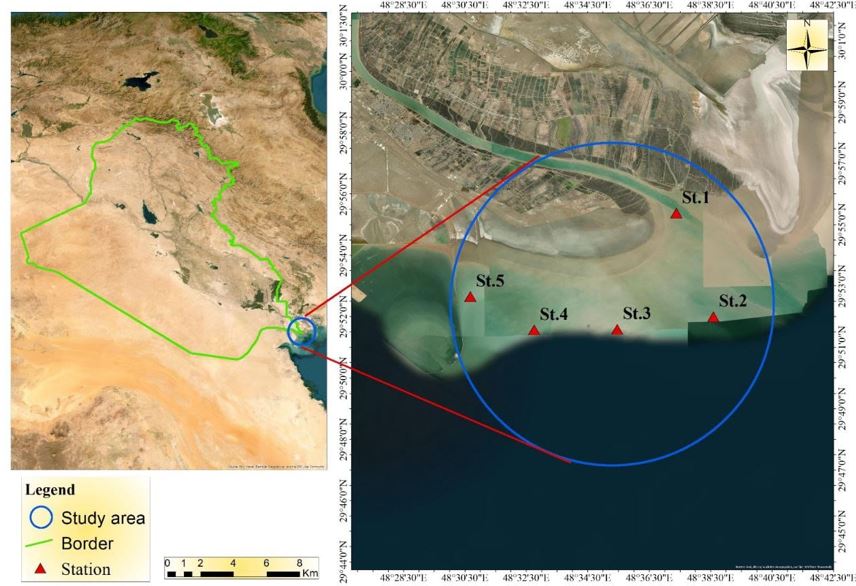
Oil pollution in the marine environment of the Arabian Gulf is an emerging threat, especially for the Iraqi coast. This study aims to evaluate the biodegradation potential of seven bacterial strains isolated from Iraqi coastal sediments for degrading aliphatic hydrocarbons (n-alkanes). The bacterial strains tested include Sphingomonas paucimobilis, Pseudomonas fluorescens, Kocuria rosea, Kocuria kristinae, Kocuria rhizophila, Staphylococcus lentus, and Pasteurella canis. Degradation efficiencies were analyzed after 48 hours, 72 hours, and 15 days. Pseudomonas fluorescens was the most efficient bacterium in terms of aliphatic hydrocarbon biodegradation (98.9% after 15 days), followed by Sphingomonas paucimobilis (96.8%) and Kocuria rhizophila (97.3%). Moreover, the results indicated that the medium-chain alkane (C14-C25) was preferentially degraded incubation time for the long-chain alkane (C26-C40). A comparative analysis of the results obtained in this study was conducted with other studies conducted in the northwestern Arabian Gulf area, including Iran and Kuwait.
Metrics
References
Al-Darbi, M. M., Saeed, T., and Al-Mutairi, N. (2017). Hydrocarbon degradation by marine bacteria from Qatari coastal waters. Mar. Pollut. Bull., 119(2), 89-96.
Al-Mailem, D. M., Sorkhoh, N. A., Al-Awadhi, H., Eliyas, M., and Radwan, S. S. (2013). Biodegradation of crude oil and pure hydrocarbons by extreme halophilic archaea from hypersaline coasts of the Arabian Gulf. Extremophiles, 17(3), 431-440.
Al-Saad, H. T., Al-Hello, M. A., Al-Taee, R. S., and Al-Khafaji, B. Y. (2017). Distribution and sources of aliphatic hydrocarbons in surface sediments of the Iraqi marine environment. Mesopotam. J. Mar. Sci., 32(1), 15-28.
Atlas, R. M., and Hazen, T. C. (2011). Oil biodegradation and bioremediation: A tale of the two worst spills in U.S. history. Environ. Sci. Technol., 45(16), 6709-6715.
Bouchez Naitali, M., Racoeur, O., and Vandecasteele, J. P. (2018). Bacterial consortia for hydrocarbon degradation: Synergistic and antagonistic interactions. J. Appl. Microbiol., 124(3), 642-653.
Cunliffe, M., and Kertesz, M. A. (2006). Effect of Sphingobium yanoikuyae B1 inoculation on bacterial community dynamics and polycyclic aromatic hydrocarbon degradation in aged and freshly PAH-contaminated soils. Environ. Pollut., 144(1), 228-237.
Das, N., and Chandran, P. (2011). Microbial degradation of petroleum hydrocarbon contaminants: An overview. Biotechnol. Res. Int., 2011, 1-13.
Fathepure, B.Z. (2014). Recent studies in microbial degradation of petroleum hydrocarbons in hypersaline environments. Front. Microbiol., 5, 173.
Goutx, M. and Saliot, A. (1980). Relationship between dissolved and particulate fatty acid and hydrocarbons, chlorophyll (a) and zooplankton biomass in Ville Franche Bay, Mediterranean Sea. Mar. Chem., 8(4): 299-318.
Hassanshahian, M., and Tebyanian, H. (2015). Isolation and characterization of crude oil-degrading bacteria from the Persian Gulf. Desalination Water Treat., 54(8), 2225-2232.
Hassanshahian, M., Zeynali, M., and Khanafari, A. (2014). Isolation and characterization of crude oil-degrading bacteria from the Persian Gulf (Khorramshahr provenance). Mar. Pollut. Bull., 82(1-2), 39-45.
Hazaimeh, M.D., and Ahmed, E.S. (2021). Bioremediation perspectives and progress in petroleum pollution in the marine environment: a review. Environmental Science and Pollution Research, 28(39), 54238-54259.
Head, I. M., Jones, D. M., and Röling, W. F. M. (2006). Marine microorganisms make a meal of oil. Nat. Rev. Microbiol., 4(3), 173-182.
Horel, A., and Schiewer, S. (2009). Biodegradation of long-chain alkanes in oil-contaminated sediments. J. Environ. Eng., 135(10), 1038-1047.
Johnsen, A. R., Wick, L. Y., and Harms, H. (2005). Principles of microbial PAH-degradation in soil. Environ. Pollut., 133(1), 71-84.
Lafta, 2 Alaa Kareem Mohammed, 3Hasan Kadhim Nimr, (2025). Genomic and Metabolic Adaptations of Hydrocarbon Degrading Bacteria in Iraq’s Surface Waters, Iraqi Journal of Biotechnology, 2025, Vol. 24, Special Issue 2, 617-622 .
Lee, Nakyeong Lee, Sangdon Ryu, Hye Seon Song, Seung-Hui Song, Yun Ji Kim, Se won Chun, Aslan Hwanhwi Lee, Jina Lee, (2026). Coastal marine bacteria with hydrocarbon-degrading capacity: Isolation, screening, and genomic insights, Marine Pollution Bulletin 225 (2026) 119226 , https://doi.org/10.1016/j.marpolbul.2026.119226.
Mulligan, C. N. (2005). Environmental applications for biosurfactants. Environ. Pollut., 133(2), 183-198.
Olowomofe, O.; Oluyege, J.O.; Aderiye, B.I. and Oluwole, O.A. (2019).Degradation of poly aromatic fractions of crude oil and detection of catabolic genes in hydrocarbon-degrading bacteria isolated from Agbabu bitumen sediments in Ondo State , AIMS Microbiology, 5(4): 308–323.
Prince, R. C., Parkerton, T. F., and Lee, C. (2007). The primary aerobic biodegradation of crude oil in the environment. Proc. Int. Oil Spill Conf., 2007(1), 1-8.
Radwan, S. S., Al-Mailem, D. M., and Kansour, M. K. (2019). Hydrocarbon-utilizing bacteria of the Arabian Gulf coast: Molecular characterization and potential for bioremediation. Int. Biodeterior. Biodegradation, 140, 65-72.
Rahimnejad, M., Mesghari, H., and Najafpour, G.D. (2015). Isolation and characterization of crude oil-degrading bacteria from the Persian Gulf. J. Environ. Health Sci. Eng., 13(1), 1-7.
Rojo, F. (2009). Degradation of alkanes by bacteria. Environ. Microbiol., 11(10), 2477-2490.
Temitayo, O.O.; Olaoluwa, J.O.; Paul I.O.; Ayodele O.O., and Solomon T.O. (2020). Phenotypic and Molecular Screening of Laccase-producing Bacteria Isolated from Automobile Workshop Soil Samples in Ado-Ekiti, International Journal of Microbiology and Biotechnology 2020; 5(3): 97-102 http://www.sciencepublishinggroup.com/j/ijmb , doi: 10.11648/j.ijmb.20200503.14 .
Van Beilen, J. B., and Funhoff, E. G. (2005). Expanding the alkane oxygenase toolbox: New enzymes and applications. Curr. Opin. Biotechnol., 16(3), 308-314.
Van Beilen, J. B., and Funhoff, E. G. (2007). Alkane hydroxylases involved in microbial alkane degradation. Appl. Microbiol. Biotechnol., 74(1), 13-21.
Whyte, L. G., Bourbonnière, L., and Greer, C. W. (1997). Biodegradation of petroleum hydrocarbons by psychrotrophic Pseudomonas strains possessing both alkane and naphthalene catabolic pathways. Appl. Environ. Microbiol., 63(9), 3719-3723.
Yakimov, M. M., Timmis, K. N., and Golyshin, P. N. (2007). Obligate oil-degrading marine bacteria. Curr. Opin. Biotechnol., 18(3), 257-266.
Downloads
Published
How to Cite
Issue
Section
License
Copyright (c) 2026 Iraqi Journal of Aquaculture

This work is licensed under a Creative Commons Attribution 4.0 International License.