A comparative study of rotifer community in two lotic vs. Lentic environments
Keywords:
Rotifers community, Garmat-Ali River, aquatic environments.Abstract
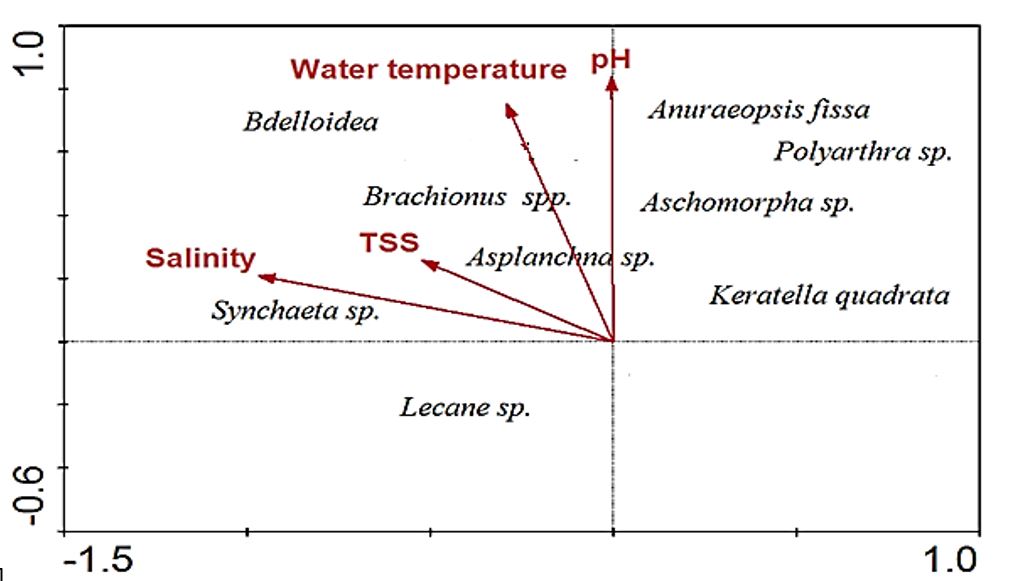
Rotifera population was studied at two stations: the first was in the Garmat -Ali River, and the second in the fish farming ponds of the Marine Science Center at the University of Basrah. Monthly samples were collected for four months, from February to May 2023, using a 40 cm diameter plankton net with a mesh 53-µm aperture. One hundred liters of water were filtered. Some environmental parameters were measured, including water temperature, pH, salinity, and total suspended solids. The quantitative and qualitative composition of the Rotifer population was also studied using modern taxonomic references. Water temperature ranged from 19-25°C at station one, while at station two it ranged from 20-27°C. The lowest salinity value (1.75 g/l) was recorded at station one, and the highest (38.5 g/l) at station two. pH values ranged from 7.11 to 8.19, with the lowest and highest values recorded at station one. The highest total suspended solids (TSS) values were recorded at station two during April, and the lowest at station one during February. The density of Rotifer was highest at station one, reaching 4.186 individuals/L during May, and lowest at station two (1.395 individuals/l). Nine genera of Rotifer were identified, with the highest number of species recorded at station one during May and the lowest at station two during February. The aim of the study is to compare the qualitative and quantitative composition of the rotifer community between two different environments. The study showed that both environments exhibited homogeneous diversity and densities of the phylloxera community, but the river environment showed the emergence of species that disappeared in the basin environment. This is due to the diversity of food resources along the river, while the basin environment is limited and depends on fertilization seasons.
Metrics
References
Ahmed, H. K. and Ghazi, A. H. (2009). A taxonomical and environmental study of the genus Brachionus (Rotifera: Monogononta) (Pallas, 1776) in Al-Hammer marsh, south of Iraq. Iraqi J. Aqua., 6(2): 105-112.
Ahmed, H. K. and Mohammed, H. H. (2006). The Rotifera community in the South Marshes of Iraq. Marsh Bulletin, 1(1): 54-58.
Ahmed, H. K.; Abdullah, D. S., and Ali, M. H. (2005). Monthly changes of nutrients, chlorophyll and Rotifera in the Shatt Al-Arab River, South of Iraq. Iraqi J. Aqua., 2(1):1-11.
Ajeel, S. G. (1998) Population dynamics of two branching phyla Simocephalus vetulus (Muller) & Daphnia magna (Straaus) in Basra, with reference to zooplankton. PhD dissertation, College of Science Unive. of Basra-. 154 pp. In Arabic.
Ajeel, S. G.; Ali, M. H, and Salman, S. D. (2001). Cladocera of the Shatt Al-Arab and some temporary ponds in Basra. Journal of the Valley of the Two Rivers for Marine Sciences. 16(1): 329-35. In Arabic.
Ali, M. H. and Abdullah, D. S. (1999). The biomass of rotifers in relation to the phytoplankton biomass in the Shatt Al-Arab River. Marina Mesopotamica, 4(2): 279-289.
Ali, M. H. and Ghazi, A. H. H. (2008). Structure and density of Rotifera along the Shatt al-Arab River from Qurna to Faw, southern Iraq. Scientific Conference on Marine Science, December 23-25. Marine Science Center. University of Basrah. In Arabic.
Al-Rubaie, M. A. J. (1997). An environmental study of the Al-Adhaim River and its impact on the Tigris River. Master's thesis, University of Baghdad. In Arabic.
Al-Saboonchi, A. A.; Barak, N. A., and Mohamed, A. M. (1986). Zooplankton of Garma Marshes, Iraq. J. Biol. Sci. Res., 17(1): 33-40.
Al-Suwaij, A. R. (1999). A comparative monologic study of the Shatt al-Arab estuary and the Khoura Canal. Master's thesis, College of Agriculture University of Basra. 61 pp. In Arabic.
Andrei-Emil, Briciu; Dumitru, Mihaila; Adrian, Graur; Dinu, Iulian Oprea; Alin, Prisacariu and Petrut, Ionel Bistricean (2020). Changes in the Water Temperature of Rivers Impacted by the Urban Heat Island: Case Study of Suceava City. Water, MDPI. 12(1343). 1-24. https://doi.org: 10.3390/w12051343.
APHA (American Public Health Association). (2005). Standard methods for the examination of water & wastewater. 21-st edition. Washington, DC. 1400 pp.
Chengalath, R. (1985). The Rotifera of the Canadian Arctic sea ice with description of a new species. Can. J. Zool. 63: 2212-2218.
Dan, Li.; Martin, D.; Valerio B., and Francesca V. (2026). Global characterization factors for quantifying the impacts of increasing water temperature on freshwater fish. Ecological Indicators, Elsevier, 142(1): 1-11. DOI: 10.1016/j.ecolind.2022.109201.
Dumont, H. J. (1980). Workshop on taxonomy and biogeography. Hydrobiologia 73: 205-206.
Fernando, C.H. (2002). Aguide to tropical freshwater zooplankton, identification, ecology and impact on fisheries. Backhuys publishers, Leiden.291pp.
Fradkin, S.C. (2001). Rotifer distributions in the coastal waters of the northeast Pacific Ocean. Hydrobiologia, 446/447: 173-177.
Ghazi, A. H., and Ahmed, H. K. (2008) Abundance and diversity of Rotifera in The Garmat Ali region ponds, Basra-Iraq. Iraqi J. Aqua., 5(1): 33-40.
Ghazi, A. H. (2005). Using live food in rearing larvae of Cyprinus carpio and Ctenopharygodon idella fish larvae. Master's thesis, College of Agriculture, University of Basra, 89 pages
Gurney, R. (1921). Freshwater crustacean collected by Dr. P. A. Buxton in Mesopotamica and Persia. J. Bombay Nat. Hist. Soc., 27(4): 835-844.
Hammadi, N. S.; Salman, S. D., and Al-Issa, S.A. (2012). Rotifera of the Shatt al-Arab River, Southern Iraq. Marine Science Center Publications. 256 pp. In Arabic.
Hussein, S. A. and Attee, R. S. (2000). Comparative studies on A limnological features of Shatt Al-Arab estuary and Mehejran canal. I. Seasonal Variations in abiotic factors. Basrah J. Agric. Sci., 13 (1): 49-59.
Iakovenko, N. S; Lukashanets, D.; Ejsmont-Karabin, J.; Bielańska-Grajner, I.; Ovander, E.; Fontaneto, D.; Tsavkova, V.; Pehlivanov, L.Z., and Janko, K. (2026). New data on rotifers (Rotifera) from European waterbodies. Biodiversity Data Journal. 14(1): 1-18. https://doi.org/ 10.3897/BDJ.14. e177185.
Kinnesh, M. J. (1986). Ecology of estuaries. Vol. 1, Physical and chemical aspects CRC press, Inc. Boca Raton, Florida, 254 pp.
Lawrence, C.; Sanders, E. and Henry, E. (2012). Methods for culturing Saltwater Rotifers (Brachionus plicatilis) for Rearing Larval Zebrafish. Zebrafish, 9(3): 140-146.
Li, Jiaxing; Zheng, Wenjun; Cai, Zhonglu; Ma, Jin; Li, Geng; Ma, Bo; Zhao, Jing; Li, Zhonghong; Li, Shuang; Chen, Mingkang and Gao, Chuang (2024). Changes in the Characteristics of Zooplankton Communities in Response to Shifts in the Aquatic Environment in the Shallow Waters of Northern Liaodong Bay, China. Journal Water, MDPI, 16(19): 2693-2711. https://doi.org/10.3390/w16192711.
Marshall, H. G. and Nesius, K. K. (1993). Seasonal relationships between phytoplankton composition, abundance and primary productivity in three tidal rivers of the lower Chesapeake Bay. The J. Elisha Mitchell Sci. Soc., 109 (3): 141-151.
Mohammed, M. B. (1965). A faunal study of the Cladocera of Iraq. Bull. Biol. Res. Centre, 1: 1-11.
Pennak, R. W. (1978). Freshwater invertebrates of the United States, 2nd ed. John Wiley & Sons. New York.
Piccolroaz, S.; Zhu; S.; Ladwig, R.; Carrea, L.; Oliver, S.; Piotrowski, A. P.; Ptak, M.; Shinohara, S.R.M.; Woolway, R. I., and Zhu, D. Z. (2024). Lake Water Temperature Modeling in an Era of Climate Change: Data Sources, Models, and Future Prospects. Reviews of Geophysics, AGU, 62(1): 1-52. DOI: 10.1029/2023RG000816.
Pontin, R. M. (1989). Opportunist rotifers: colonizing species of young ponds in Surrey, England. Hydrobiologia 186/187: 229-234.
Reid, G. K. (1961). Ecology of inland water and estuaries. Reinhold Publ. Corp., New York. 375 pp.
Sabri, A. W.; Ali, Z. H.; Thejar, L. A.; Shawkat, S. F., and Kassim, T. I. (1989). Vertical distribution zooplanktonic species in Samarra impoundment (Iraq). Proc. Sth Sci. Conf./SRC., 5: 256-264.
Salman, D. S.; Abbas, M. F.; Ghazi, A. M.; Ahmed, H. K.; Akash, A. N.; Douabul, A. A. Z.; Warner, B. G., and Asada, T. (2014). Seasonal changes in zooplankton communities in the red-blooded Mesopotamian wetlands, Iraq. J. Fresh. Ecol., 29(3): 397-412.
Salman, S. D., Ghazi, A. H., Abbas, M. F., Mohammed, H. H. and Ahmed, H. K. (2008). Zooplankton of the Southern Iraqi Marshes. 2. Rotifera. Final report submitted to the Canadian International Development Agency (CIDA) and Iraq Foundation by the Marine Science Centre, Basrah Univ., 24 pp
Schnack-Schiel, S. B. (2003). The macrobiology of sea ice. In Sea Ice: An Introduction to its Physics, Biology and Chemistry. (Thomas D. N. & Dieckmann, G. S. eds.) Blackwell Publishing, Inc. Malden, MA, Chapter 7.
Segers, H.; Kotethip, W., and Sanoamuang, L. (2004). Biodiversity of Thailand: the Rotifera monogononta. Hydrobiology, 515(1-3): 1-9.
Vlaardingen, P.L.A., and Verbruggen, E.M.J (2007). Guidance for the derivation of environmental risk limits within the framework of 'International and national environmental quality standards for substances in the Netherlands' (INS). National Institute for Public Health and the Environment (RIVM), Ministry of Health, Welfare and sport, 164 p. DOI: OAI.
Werner, I, and Auel, H. (2004). Environmental conditions and overwintering strategies of planktonic metazoans in and below coastal fast ice in the Gulf of Finland Baltic Sea. Sarsia., 89: 102-106.
Whitton, B. A. (1975). River Ecology. Blackwell scientific publication, Oxford. 233p.
Downloads
Published
How to Cite
Issue
Section
License
Copyright (c) 2026 Iraqi Journal of Aquaculture

This work is licensed under a Creative Commons Attribution 4.0 International License.