Bacterial assessment of raw and tap water quality in Basrah city, Iraq
Keywords:
Drinking water, total bacteria, fecal coliform, water quality.Abstract
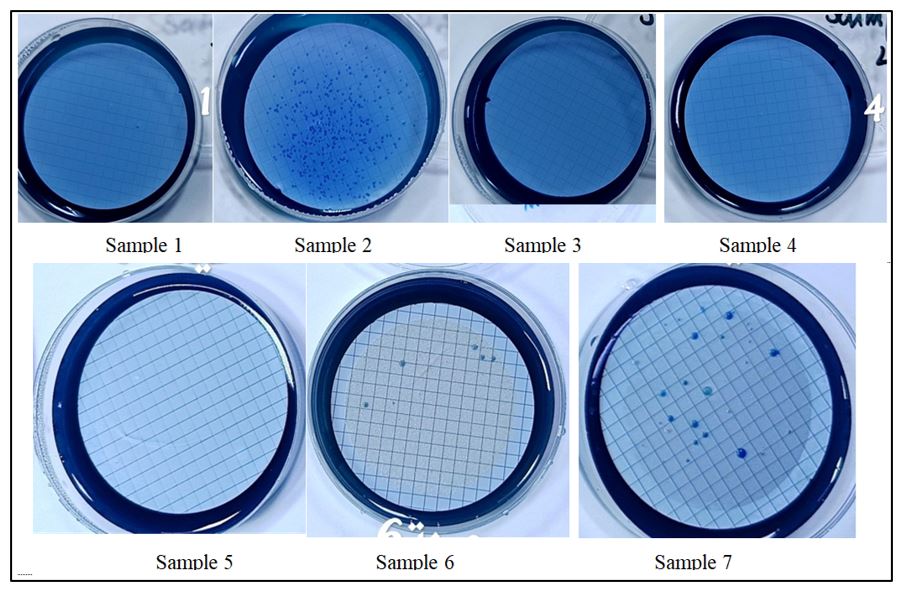
Ensuring drinking water safety is a fundamental public health priority, particularly in cities facing potential environmental risks. This study estimated the microbial and physicochemical water quality of the Shatt al-Arab River and tap water in Basrah city, Iraq. Total bacterial counts, fecal coliforms, pH and electrical conductivity (EC) were monitored in water samples obtained from different sampling points. Fecal coliform identification was carried out on M-FC agar medium incubated at 44.5°C. The bacteriological study revealed a marked geographical variation in the bacterial load. The Shatt al-Arab water samples (especially sample 2) had the highest counts of total bacteria and fecal coliforms (up to 170 CFU/100 ml) indicating direct contact with organic and fecal pollutants. On the other hand, tap water counts indicated lower but very varied contamination levels between 320 CFU/ml in Site 6 and 1200 CFU/ml in Site 7. No fecal coliforms (0 CFU/100 ml) were detected in effluent samples (Sites 3, 4 and 5), indicating the local effectiveness of the chlorination process. Structurally, a drastic fall of pH to acidity and a rise in EC values were recorded in the most polluted zones, demonstrating a strong association between the microbial metabolic activity and the damaged chemical characteristics of water. The results suggest that while chlorination has some effect, the water distribution networks in Basrah require a regular urgent monitoring and advanced treatment technologies to cope with increasing salinity and biological contamination in order to comply with Iraqi and international drinking water standards.
Metrics
References
Al-Adhab, M., (2024). Anthropogenic impacts and spatial variations of water quality parameters in the Shatt Al-Arab River network, Basrah, Iraq. Mar. Pollut. Bull, 201, 116204.
Al-Asadi, S. A. R., Al-Qurnawi, W. S., Al-Hawash, A. B., Ghalib, H. B., and Alkhlifa, N.-H. A. H. (2020). Water quality and impacting factors on heavy metals levels in Shatt Al-Arab River, Basra, Iraq. Appl. Water Sci., 10(5), Article 119. https://doi.org/10.1007/s13201-020-01193-4
Al-Baghdadi, N. M., Abbas, M. F., Al-Najare, G. A., Younis, K. H., and Karim, R. M. (2024). Monitoring environmental changes in the Shatt al-Arab River using the organic pollution index (OPI) and two species of benthic invertebrates Melanoides tuberculata and Neritina violacea. Egypt. J. Aquat. Biol. Fish., 28(3), 889–909.
Al-Bahadily, A. F., and Al-Sadi, A. G. (2020). Diversity and adaptation of halotolerant bacteria in the Shatt Al-Arab River under varying salinity conditions. Iraqi J. Sci., 61(4), 812–825.
Al-Hajaj, W., and Turab, M. (2025). Spatial and temporal variations of some chemical characteristics for water quality of Shatt Al-Arab River/ Basrah-South of Iraq. Basrah Res. Sci, 51(2), 45–60. https://doi.org/10.56714/bjrs.51.2.5
Al-Hello, A. A., Al-Obaidy, A. M., and Al-Saadi, J. H. (2021). Evaluation of the bacterial load in Shatt Al-Arab River near sewage discharge points, Basrah, Iraq. Basrah J. Sci., 39(2), 188–205.
Al-Imarah, F. J., Al-Sayab, A. A., and Al-Taein, S. M. (2015). Impact of organic pollution on physicochemical properties and bacterial growth in Shatt Al-Arab River, Southern Iraq. Basrah J. Agric. Sci., 28(2), 74–89.
Al-Jaberi, Z. A., and Al-Abbawy, D. A. (2023). Assessing the microbial safety of drinking water in Basrah Province: A study of three water treatment plants. IOP Conf. Ser.: Earth Environ. Sci., 1215(1), Article 012056. https://doi.org/10.1088/1755-1315/1215/1/012056
Allafta, H., and Opp, C. (2020). Spatio-temporal variability and pollution sources identification of the surface sediments of Shatt Al-Arab River, Southern Iraq. Sci. Rep., 10(1), Article 6389. https://doi.org/10.1038/s41598-020-63893-w
Al-Saffar, M. S. (2021). Evaluating the impact of water distribution network age and distance on chlorine residual levels in Basrah City. Basrah J. Eng. Sci., 21(1), 15–28.
Al-Saffar, M. S., and Hameed, A. K. (2020). Evaluation of chlorine effectiveness in high salinity water: A case study of Basrah water treatment plants. Iraqi J. Civ. Eng., 14(2), 33–45.
Al-Yasiry, H. K. M. (2021). The effect of climate changes on the hydrological characteristics of the Shatt al-Arab River 1972-2021. J. Basrah Res. (Sci.), 46(3), 112–135.
Chalabi, A. S. A., Naeem, S. M., and Alkhafaji, R. J. (2023). Water Quality Index (WQI) for main water treatment plants in Basra City, Iraq. Int. J. Des. Nature Ecodyn., 18(6),
Dąbrowska, D., Sołtysiak, M., Biniecka, P., Michalska, J., Wasilkowski, D., Nowak, A., and Nourani, V. (2019). Application of hydrogeological and biological research for the lysimeter experiment performance under simulated municipal landfill condition. J. Mater. Cycles Waste Manag., 21(6), 1477–1487. https://doi.org/10.1007/s10163-019-00900-x
Faroon, M. A., Yaseen, D. A., and Saad, Z. A. A. A. (2023). A new modeled equation of the Water Quality Index for examination of the water quality of treatment plants in Basra City (Iraq). Environ. Res. Eng. Manag., 79(1), 110–121. https://doi.org/10.5755/j01.erem.79.1.32707
Gao, J., Feng, W., Yang, F., Liu, J., Fan, W., Wang, Y., Zhang, Q., and Yang, W. (2022). Effects of water quality and bacterial community composition on dissolved organic matter structure in Daihai lake and the mechanisms. Environ. Res., 214(Part 4), Article 114109. https://doi.org/10.1016/j.envres.2022.114109
Geldreich, E. E., Clark, H. F., Huff, C. B., and Best, L. C. (1965). Fecal-coliform-organism medium for the membrane filter technique. J. Am. Water Works Assoc., 57(2), 208–214. https://doi.org/10.1002/j.1551-8833.1965.tb01388.x
Grabow, W. O. (1996). Bacteriological evidence of faecal pollution in water. Water SA, 22(2), 193–202.
Hameed, A. K., and Al-Saffar, M. S. (2019). Assessment of bacterial regrowth in drinking water distribution systems: A case study of Basrah Province. Al-Basrah J. Eng. Sci., 19(1), 12–24.
Hamzah, Z. A. H. (2025). Water quality of the Shatt Al-Arab River evaluation using the Nemerow pollution index method. Adv. Sci. Technol. Res. J., 19(5), 14–20. https://doi.org/10.12913/22998624/201132
International Organization for Standardization. (1985). Water quality – Determination of electrical conductivity (ISO Standard No. 7888:1985).
International Organization for Standardization. (2023). Water quality — General requirements and guidance for the enumeration of microorganisms by culture (ISO Standard No. 8199:2023).
Jiang, S. (2023). Toxic metals and corrosive pipes in the United States water distribution systems. Research Archive. https://doi.org/10.58445/rars.309
Kumari, S., and Das, S. (2023). Bacterial enzymatic degradation of recalcitrant organic pollutants: catabolic pathways and genetic regulations. Environ Sci Pollut Res 30, (34), 79676–79705. https://doi.org/10.1007/s11356-023-28130-7
Li, P., and Wu, J. (2022). Methods for microbiological analysis of water. In Environmental water quality (pp. 210–235). Springer Nature.
Madigan, M. T., Martinko, J. M., Bender, K. S., Buckley, D. H., and Stahl, D. A. (2015). Brock biology of microorganisms (14th ed.). Pearson.
Mahon, C. R., and Lehman, D. C. (2019). Textbook of diagnostic microbiology (6th ed.). Elsevier Health Sciences.
Oren, A. (2008). Microbial life at high salt concentrations: phylogenetic and metabolic diversity. Saline Systems, 4(1), 1–13.
Ramal, M. M., Jalal, A. D., and Abdulhameed, U. H. (2021). Heavy metal assessment in taps drinking water of Ramadi city using water quality Indices, Anbar Province, Iraq. Int. J. Sustain. Dev. Plann., 16(7), 1349–1357. https://doi.org/10.18280/ijsdp.160715
Saied, A.S., Mousa, A.A. and Abdo, A.M. (2025). Seasonal variations in microbial and physicochemical parameters of Nile river water in Giza, Egypt: comparison of IDEXX and conventional methods. BMC Biotechnol 25, 138 https://doi.org/10.1186/s12896-025-01076-z
Sanders, E. R. (2012). Aseptic technique for the microbial laboratory. J. Vis. Exp., (63), Article e3699. https://doi.org/10.3791/3699
Shibata, T., Solo-Gabriele, H. M., Fleming, L. E., and Elmir, S. M. (2004). Monitoring marine recreational water quality using multiple microbial indicators in an urban tropical environment. Water Res., 38(13), 3119–3131. https://doi.org/10.1016/j.watres.2004.04.044
Taloob, K. A., and Al-Mahmood, H. K. (2025). Evaluation of Shatt Al-Arab River water suitability for drinking and agricultural irrigation: A comprehensive spatial analysis. Basrah J. Agric. Sci., 56(1), 112-125.
Tokajian, S., and Hashwa, F. (2003). Bacterial regrowth and presence of opportunistic pathogens in drinking water distribution systems. Curr. Microbiol., 46(3), 166–173. https://doi.org/10.1007/s00284-002-3843-z
Tripura, J., and Singh, S. (2024). Assessment of physiochemical parameters of the Tawi River of Jammu and Kashmir, India for drinking and agricultural purposes. J. Hydroinformatics, 26(11), 2739–2750. https://doi.org/10.2166/hydro.2024.093
United States Environmental Protection Agency. (2002). Method 1604: Total Coliforms and Escherichia coli in Water by Membrane Filtration using a Simultaneous Detection Technique (Report No. EPA-821-R-02-024). EPA.
Wali, H. F., Majid, W. N., Naeemah, Y. S., and Waheeb, M. Q. (2024). Detection of biological and physicochemical contaminants in drinking water in Al-Samawa City. Microb. Sci. Arch. https://api.semanticscholar.org/CorpusID:274508150
Wang, Z., Yang, X., Fu, L., and Li, M. (2025). A review of secondary contamination of drinking water quality in distribution systems: Sources, mechanisms, and prospects. AQUA-Water Infrastr. Ecosyst. Soc., 74(1), 118–141. https://doi.org/10.2166/aqua.2024.284
Weerakoon, W. M. T. D. N., Jayathilaka, N., and Seneviratne, K. N. (2023). Chapter 14 - Water quality and wastewater treatment for human health and environmental safety. In V. Kumar, M. Bilal, S. K. Shahi, and V. K. Garg (Eds.), Dev. Appl. Microbiol. Biotechnol., Metagenomics to Bioremediation (pp. 357–378). Academic Press. https://doi.org/10.1016/B978-0-323-96113-4.00031-7
World Health Organization. (2022). Guidelines for drinking-water quality: Small water supplies. World Health Organization.
Downloads
Published
How to Cite
Issue
Section
License
Copyright (c) 2026 Iraqi Journal of Aquaculture

This work is licensed under a Creative Commons Attribution 4.0 International License.