Occurrence and Abundance Ratios of Alien versus Native Species in the Fish Assemblages of the Southern Iraqi Marshlands
Keywords:
Iraqi marshlands, Mesopotamia marshes, Marshes alien species, Wetlands exotic fish, Marshland native fish.Abstract
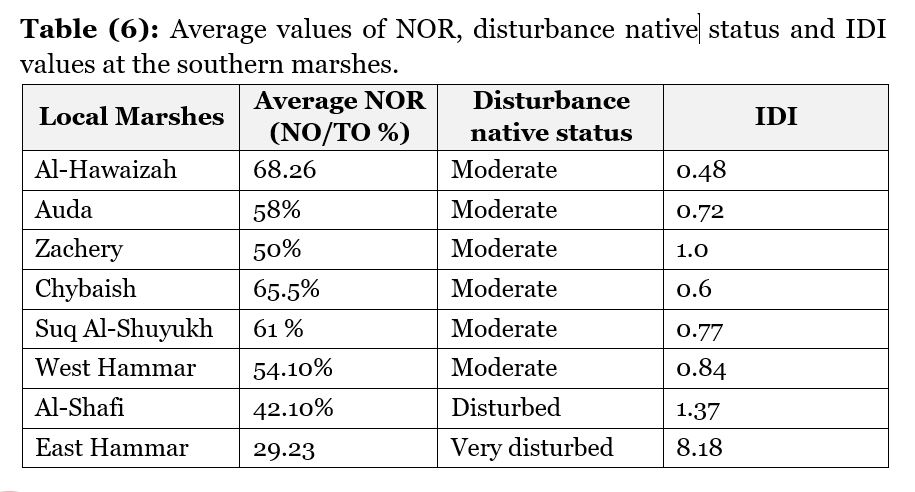
The degree of disturbance at fish assemblages in southern Iraqi marshes was quantified on the basis of number of native species occurrence ratio (NOR) and native abundance ratio (NAR) to the total number of species and individuals during the period from 2006 to 2024. Degree of disturbance status scores at Al-Hawaizah, Auda, Chybaish, Zachery, Dalmaj, West Hammar and Suq Al-Shuyukh marshes ranged between 50 -77% ,which equal to moderate and fine in disturbance status scale. Al-Shafi and East Hammar marshes express lower native occurrence ratio ranged 24-42% equal to disturbed to very disturbed status. Alien species number were varied between 3 to 11. Highest native species occurrence ratio (NOR) conceded with low salinity values at Al-Hawaizah, Chybaish, Auda, and West Hammer. The opposite case was in Al-Shafi and East Hammar marshes were alien species dominated. Invasive disturbed index (IDI) values s express negative relationship with number of native species and positive with alien species ratio at the southern marshes. IDI score at Al-Hawaizah , Auda, Zachery, Suq Al-Shuyukh and west Hammar marshes were low, ranged from 0.3 to 1.0. On contrary East Hammer marsh and Al Shafi scored the highest IDI values ranged from 1.37 to 3.6. Alien species had established successfully in southern marshes over relatively a short period. Native fluvial species lost its dominance to alien species especially in Al-Shafi and East Hammer marshes. Gradual decrease in occurrence and abundance of native species was noticed in southern marshes due to increase salinity. Alien species seem to be infested all Iraqi southern marshes. The most sever disturbance ratio was recorded at East Hammar marsh.
Metrics
References
Abdalhsan, H.T. (2019). “Study of zonation and ecological indices for fish assemblage in East Hammar marsh ,Southern Iraq,” University of Basrah,129p.
Abdalhsan, H. T., Hussain, N. A., & Abduijaleel, S. A. (2020). Ecological impacts of exotic and marine migratory species on the fish's composition assemblage in East Hammar marsh/south Iraq. Marsh Bulletin, 15(1), 52-61.
Abdullah, A. H. J. (2023). The Impact of Hydrological Changes on Fish Assemblages in the Zachery Marshes of Southern Iraq. In IOP Conference Series: Earth and Environmental Science (Vol. 1215, No. 1, p. 012049). IOP Publishing.
Abdullah, A. H. J.; Abdullah, S. A.; Ziyadi, M. S. and AL-Faiz, N. A. (2022). Investigation of changes in the fish assemblage building and abundance in the Garmat Ali River, Southern Iraq. Fish Taxa-Journal of Fish Taxonomy, 25. 31-40.
Abdullah, S. A., Ouda Y W and Zeidan, A. M. (2017). Fish Community in the Lower of the Euphrates River, Thi–Qar city, Iraq. Diyala Agricultural Sciences Journal, 9(special Issue), 37-50.
Al-Fasial ,A. J. and Mutlak, F. M. (2014). Exotic freshwater fishes in the southern Iraq, Marsh Bull., 9:. 65–78.
Al-Fasial A J .(2020). Updating checklist of freshwater fishes of Iraq,” Mesopo. Environ. J,. 5 ( 4): 1–7.
Al-Jabre, H., & Hussain, N. A. (2024). Composition and Ecological Indices of the Fish Assemblage at West Hammar Marsh, Southern Ira, Al-Muthanna J. For Agricultural Science, 11(1):1-9.
AL-Shamary, A.Ch. (2016). Assessment Environment of Al-Chybaish marsh between 2004-2009 by (IBI) Integrated Biological Index. Journal of Basrah Researches Sciences 42(1), Arabic.
Al-Thahaibawi, B. M. H., Younis, K. H., & Al-Mayaly, I. K. (2019). Fish assemblage structure in Al-Hawaizah marsh southern of Iraq after inscribed on the World Heritage List. Iraqi Journal of Science, 1430-1441. *
Al-Thalibawi, B., Al-Mayaly, I. and Al-Hiyaly, S. (2015). Composition structure of fish assemblage in Al-Auda marsh Southern Iraq. Proceeding of the 6th National Conference on Environment and Natural Resources. Basrah 0-11 November, 1-33.
Al-Zaidy, K. J., Parisi, G., Abed, S. A., & Salim, M. A. (2019). Classification of the key functional diversity of the marshes of southern Iraq marshes. Journal of Physics: Conference Series (Vol. 1294, No. 7, p. 072021). IOP Publishing.
ARDI (2006). (Agricultre, Reconstruction and Development program for Iraq). Final report, marshlands monitoring team. DAI (Development Alternative International) USAID, , 172pp.
CIMI(2006). (Canadian Iraqi Marsh Initiatives) Annual final fish report "Species composition, ecological indices, length frequencies and food habits of fish assemblages of the restored southern Iraqi marshes, "by Hussain N A, Mohamed A R M, AL Noor S S, Coad B W Mutlak, F.M.; ALSudani, I.M.; Mojer, A.M; Toman A J and Abdad M A CIMI research group conference and field training session. October 2006.Damascus, Syria.114p.
Habeeb M K., Al-Shaheen M A, Abbas A F, Hamza H A, Okash A N, Hussain N A and Reiss P. (2023). The fragile ecology in Iraq’s Mesopotamian marshlands endangered and restructured by a sharp increase in salinity. GSC Advanced Research and Reviews, 16(1), 007-018.
Hameed, E .K. (2014). Study of fish composition n Karmet Ali River, south of Iraq, University of Basrah.
Hameed, E .K. (2014). Study of fish composition n Karmet Ali River, south of Iraq,MSc.thesis, University of Basrah 101p.
Hasan ,K.H. and Resen, A.K. (2019). Fish Assemblage of Ktiban creek the upper Reach of Shatt Al-Arab River,” Basrah J. Agric. Sci., vol. 32, pp. 98–123.
Hussain N. A, Mohamed A. R. M., Al- Noor, S. S., Mutlak F. M .Abed, I. M. and Coad, B. W. (2009). Structure and ecological indices of fish assemblages in the recently restored Al-Hammar Marsh, southern Iraq approaches. BioRisk Journal, 3, 173-186.
Hussain, N. A., (2014). Biotopes of the Iraqi marshes, Dhifaf publishing house, Buriet Lebnan 432pp (Arabic).
Hussain, N.A. and Reiss, P. (2018). Program sustainability and impact twelve years later: USAID Iraq Marshlands Restoration Program (IMRP).DAI, Bethesda, Maryland. 119 p.
IMRP (2006). (Iraq Marshlands restoration Programme) Monitor marsh Ecosystem Recovery. Final report. USAID/development Alternative Inc. 528pp.
Karr, James R., (1986). "Assessing biological integrity in running waters." A method and its rationale. Illinois Natural History Survey, Champaign, Special Publication 5: 1-28.
Khalaf, K.T. (1961). The marine and freshwater fishes of Iraq.Al-Rabitta Press. Baghdad .Iraq. 164 pp.
Larentis, C., Kotz Kliemann, B. C., Neves, M. P., & Delariva, R. L. (2022). Effects of human disturbance on habitat and fish diversity in Neotropical streams. Plos one, 17(9), e0274191.
Lazem, L.F. (2009) Structural composition of fish assemblages and their relation with biotic factors of Karmat Ali river river, southern Iraq. MSc thesis, Basrah university.
Mohamed A.R. M., N. A. Hussain, and S. S. Al-noor (2012). “Ecological and biological aspects of fish assemblage in the Chybayish marsh , Southern Iraq,” Ecohydrol. Hydrobiol.
Mohamed, A. R. M.; Al-Sabunji, A. A and Radi. F. K. (2015). Changes in the composition of the marsh fish population, East Hammar, southern Iraq. Journal of King Abdulaziz University: Marine Sciences, 25 (2), 159-182. (Arabic).
Mohamed, A. R. M.; Hussein, S. A. and Lazem, L. F. (2013). Study of the fish community of Karma Ali River, north of Basra, Iraq. Basrah Journal of Agricultural Sciences, 26 (1).)Arabic). 150-166.
Mohammed, I .A. (2024). Assessment of the Status of the Aquatic Environment in Eastern Hammar Marsh by Applying Diversity Indices and Biodiversity Intactness Index. Unpublished MSC thesis, University of Basrah, Iraq.
Richardson C. J. and Hussain N. A. Restoring the Garden of Eden: an ecological assessment of the marshes of Iraq. BioScience, (2006). 56(6), 477-489.
Shannon, C. E., & Weaver, W. (1949).The mathematical theory of communication. Univ.illinos press. 386pp.
Vicente, I. S. T. and Fonseca-Alves, C. E. (2013). “Impact of Introduced Nile tilapia (Oreochromis niloticus) on Non-native Aquatic Ecosystems.,” Pakistan J Biol Sci, vol. 16, no. 3, pp. 121–126,.
Younis, K.H., Al-Mosawi, M.H. and Jaber, A.A. (2011). Composition structure of fish assemblage in Um Alnaaaj, Al-Hawaizah marsh-Iraq. Basrah Scientific Research. Vol 37 (2):49-59.
Youns, K. H. and Al- Shamary, A.Ch. (2012). providing a final assessment of the Hawaizah Marsh environment for the period 2004-2010 using the Bio-Integration Guide. Fourth Conference on Environmental Sciences.
Downloads
Published
How to Cite
Issue
Section
License
Copyright (c) 2026 Iraqi Journal of Aquaculture

This work is licensed under a Creative Commons Attribution 4.0 International License.