Assessment of Physico-Chemical Characteristics and Macronutrient Distribution in The Water of Khor Al-Zubair, North Weast Arabian Gulf, Iraq
Keywords:
KhorAl-Zubair, Nutrients, environment, aquatic systemsAbstract
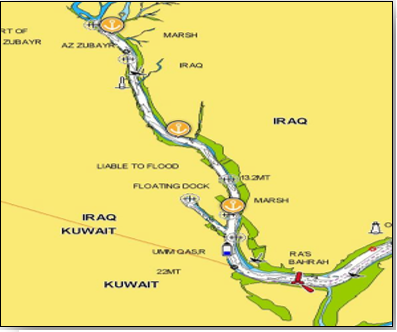
The study was conducted in the Khor Al-Zubair channal in the northwestern Arabian Gulf, where water samples were collected ly (summer and winter) from a depth of 10 cm during low tide at three stations in Khor Al-Zubair (Khor Al-Zubair Port, Al-Nafq, and Umm Qasr Port). A range of physicochemical parameters was measured, including (temperature, salinity, dissolved oxygen, pH, total nitrogen (TN), nitrite, nitrate, total phosphorus (TP), calcium, magnesium, and silica). The results showed clear variations in water quality indicators, with the stations (Khor Al-Zubair Port, Al-Nafq, and Umm Qasr Port) recorded the highest temperature levels (30 °C) during the summer and salinity (50 mg/L) during the summer at the third station (Umm Qasr Port), while the pH (pH) (7.62) during the summer at the third station (Umm Qasr Port), while dissolved oxygen decreased during the summer, recording (6.7 mg/L) at the first station (Khor Al-Zubair Port). As for the major nutrients, the results showed clear spatial and variations, with the highest total nitrogen value recorded during the winter at the third station (Umm Qasr Port), reaching 3.1 µg/L. Similarly, nitrite and nitrate values during the winter also coincided at the Khor Al-Zubair Port station, reaching 1.99 µg/L and 4.49 µg/L, respectively. In contrast, the highest total phosphorus value during the summer was recorded at the Umm Qasr Port station, reaching 0.297 µg/L, accompanied by the highest silica concentration at the same station and during the same season, reaching 6.08 mg/L As for the other elements, the highest concentrations of calcium and magnesium were recorded during the winter at the Tunnel Station, reaching 384.24 mg/L and 1,351.01 mg/L, respectively.
Metrics
References
Al-Saad, H. T., Abd, I. A., Al-Hello, M. A., & Zuhkair, M. K. (2007). Environmental assessment of trace metals pollution in sediment of Khor Al-Zubair, Iraq. Marina Mesopot., 22(1), 81–92.
Al-Shahri, Y. J., Maulood, B. K., & Toma, J. J. A. (2016). Study on a sulfur spring (Ain Al Kibrit) ecosystem along Tigris River Mosul, Iraq. J. Adv. Lab. Res. Biol., 7(1), 1–8. https://e-journal.sospublication.co.in/index.php/jalrb/article/view/251
Al-Taee, A. M. (2001). Assessment of water quality due to microbial growth in drinking water distribution systems in Basrah city. Mar. Mesopot., 16(1), 37–46.
APHA. (2005). Standard methods for the examination of water and wastewater (21st ed.). American Public Health Association, American Water Works Association, and Water Environment Federation. 1368 pp.
Bennett, E. M., Carpenter, S. R., & Caraco, N. F. (2001). Human impact on erodible phosphorus and eutrophication: A global perspective. BioScience, 51(3), 227–234. https://doi.org/10.1641/0006-3568(2001)051[0227:HIOEPA]2.0.CO;2
Bernard, C. Y., Dürr, H. H., Heinze, C., Segschneider, J., & Meier-Reimer, E. (2011). Contribution of riverine nutrients to the silicon biogeochemistry in the global ocean—a model study. Biogeosciences, 8(3), 551–564. https://doi.org/10.5194/bg-8-551-2011
Bernard, C. Y., Laruelle, G. G., Slomp, C. P., & Heinze, C. (2010). Impact of changes in river fluxes of silica on the global marine silicon cycle: a model comparison. Biogeosciences, 7(2), 441–453. https://doi.org/10.5194/bg-7-441-2010
Cloern, J. E., Abreu, P. C., Carstensen, J., Chauvaud, L., Elmgren, R., Grall, J., Greening, H., Johansson, J. O. R., Kahru, M., Sherwood, E. T., Xu, J., & Yin, K. (2016). Human activities and climate variability drive fast-paced change across the world's estuarine-coastal ecosystems. Glob. Chang. Biol., 22(2), 513–529. https://doi.org/10.1111/gcb.13059
Costanza, R., de Groot, R., Sutton, P., van der Ploeg, S., Anderson, S. J., Kubiszewski, I., Farber, S., & Turner, R. K. (2014). Changes in the global value of ecosystem services. Glob. Environ. Change, 26, 152–158.
https://doi.org/10.1016/j.gloenvcha.2014.04.002
Dewald, P., Jonathan, M., Friedrich, N., Rohrer, F., Tillmann, R., Reimer, D., Xu, K., Holzinger, R., Bernard, F., Zhou, L., Brown, S., Fuchs, H., & Crowley, J. (2020). Evolution of NO3 reactivity during the oxidation of isoprene. Atmos. Chem. Phys., 20(17), 10459–10475. https://doi.org/10.5194/acp-20-10459-2020
Fantle, M. S., & Tipper, E. T. (2014). Calcium isotopes in the global biogeochemical Ca cycle: Implications for development of a Ca isotope proxy. Earth-Sci. Rev., 129, 148–177. https://doi.org/10.1016/j.earscirev.2013.10.004
Filipova, V., Aruna, R., & Prasoon, S. (2012). Urban flooding in Gothenburg – A Mike 21 study. J. Water Manag. Res., 68, 175–184.
Flörke, M., Bärlund, I., van Vliet, M. T., Bouwman, A. F., & Wada, Y. (2019). Analysing trade-offs between SDGs related to water quality using salinity as a marker. Curr. Opin. Environ. Sustain., 36, 96–104. https://doi.org/10.1016/j.cosust.2019.01.002
Gruber, N. (2023). The marine nitrogen cycle: Overview and recent advances. Annu. Rev. Mar. Sci., 15, 281–307. https://doi.org/10.1146/annurev-marine-032122-025607
Hammoumi, D., Al-Aizari, H. S., Alaraidh, I. A., Okla, M. K., Assal, M. E., Al-Aizari, A. R., Moshab, M. S., Chakiri, S., & Bejjaji, Z. (2024). variations and assessment of surface water quality using Water Quality Index (WQI) and Principal Component Analysis (PCA): A case study. Sustainability, 16(13), 5644.
https://doi.org/10.3390/su16135644
Hong, H., Chen, N., & Wang, D. (2015). River-estuary-coast continuum: Biogeochemistry and ecological response to increasing human and climatic changes—Editorial overview. Estuar. Coast. Shelf Sci., 166, 144–145.
https://doi.org/10.1016/j.ecss.2015.08.012
Jassim, I. N., & Al-Amiri, N. J. (2023). Indicate the pollution extent at Shatt Al-Arab waters by water quality index (Canadian model). J. Surv. Fish. Sci., 10(3S), 2737–2754. https://doi.org/10.53555/sfs.v10i3S.1751
Koc, J., Sobczyńska-Wójcik, K., & Skwierawski, A. (2008). Magnesium concentrations in the waters of re-naturised reservoirs in rural areas. J. Elem., 13(3), 329–340. http://dx.doi.org/10.5601/jelem.2008.13.3.05
Kroupova, H., Machova, J., & Svobodova, Z. (2005). Nitrite influence on fish: A review. Vet. Med. Czech, 50(11), 461–471. https://doi.org/10.17221/5650-VETMED
Kumar, A., Bisht, B. S., Joshi, V. D., Singh, A. K., & Talwar, A. (2010). Physical, chemical and bacteriological study of water from rivers of Uttarakhand. J. Hum. Ecol., 32(3), 169–173
Lafta, A. A., & Abdullah, S. S. (2025). Hydrodynamic characteristics of Khor Al Zubair Channel, Southern Iraq. Vietnam J. Mar. Sci. Technol., 25(1), 103–112. https://doi.org/10.15625/1859-3097/19888
Lafta, A. A., Altaei, S. A., & Al Hashimi, N. H. (2020). Impacts of potential sea level rise on tidal dynamics in Khor Abdullah and Khor Al Zubair, Northwest of Arabian Gulf. Earth Syst. Environ., 4(2), 331–343. https://doi.org/10.1007/s41748-020-00147-9
Laruelle, G. G., Roubeix, V., Sferratore, A., Brodherr, B., Ciuffa, D., et al. (2009). Anthropogenic perturbations of the silicon cycle at the global scale: Key role of the land‐ocean transition. Glob. Biogeochem. Cycles, 23(4), GB4031. https://doi.org/10.1029/2008GB003267
Li, J., He, Y., Xie, T., Song, Z., Bai, S., Zhang, X., & Wang, C. (2025). variations and drivers of total nitrogen and phosphorus in China’s surface waters. Water, 17(4), 512. https://doi.org/10.3390/w17040512
Louis, J., Guieu, C., & Gazeau, F. (2017). Nutrient dynamics under different ocean acidification scenarios in a low nutrient low chlorophyll system: The Northwestern Mediterranean Sea. Estuar. Coast. Shelf Sci., 186, 30–44. https://doi.org/10.1016/j.ecss.2015.07.014
Ma, J., & Byrne, R. H. (2012). Flow injection analysis of nanomolar silicate using long pathlength absorbance spectroscopy. Talanta, 88, 484–489. https://doi.org/10.1016/j.talanta.2011.11.020
Ma, J., Adornato, L., Byrne, R. H., & Yuan, D. (2014). Determination of nanomolar levels of nutrients in seawater. TrAC Trend. Anal. Chem., 60, 1–15. https://doi.org/10.1016/j.trac.2014.04.013
Mohammad, A. J., Alyousif, N. A., Al-Mosawi, U. A. S., & Al-Hejuje, M. M. (2021). Variation of water quality and trophic status of Khor Al-Zubair canal, Southern Iraq. J. Phys. Conf. Ser., 1999(1), 012012. https://doi.org/10.1088/1742-6596/1999/1/012012
Mohr, W., Großkopf, T., & LaRoche, J. (2022). Recent advances in marine nitrogen cycling. Nat. Rev. Microbiol., 20(12), 741–757. https://doi.org/10.1038/s41579-022-00752-y
Ngatia, L., Grace, J. M., Moriasi, D., & Taylor, R. (2019). Nitrogen and phosphorus eutrophication in marine ecosystems. In: Monitoring of Marine Pollution. IntechOpen, 1–17. https://doi.org/10.5772/intechopen.81816
Oceanic Institute. (2019). Aqua Facts. Retrieved December 1, 2018, from https://web.archive.org/web/20190103114836/http://oceanicinstitute.org/aboutoceans/aquafacts.html
Paerl, H. W. (2009). Controlling eutrophication along the freshwater–marine continuum: Dual nutrient (N and P) reductions are essential. Estuaries Coasts, 32(4), 593–601. https://doi.org/10.1007/s12237-009-9158-8
Quade, J., English, N., & DeCelles, P. G. (2003). Silicate versus carbonate weathering in the Himalaya: A comparison of the Arun and Seti River watersheds. Chem. Geol., 202(1-2), 275–296. https://doi.org/10.1016/S0009-2541(02)00330-X
Ragueneau, O., Tréguer, P., Anderson, R. F., Brzezinski, M. A., DeMaster, D. J., et al. (2000). A review of the Si cycle in the modern ocean: recent progress and missing gaps in the application of biogenic opal as a paleoproxy. Glob. Planet. Change, 26(1-3), 317–365. https://doi.org/10.1016/S0921-8181(00)00052-7
Razmkhah, H., Abrishamchi, A., & Torkian, A. (2010). Evaluation of spatial and temporal variation in water quality by pattern recognition techniques: A case study on Jajrood River (Tehran, Iran). J. Environ. Manage., 91(4), 852–860. https://doi.org/10.1016/j.jenvman.2009.11.001
Ridgwell, A., & Zeebe, R. E. (2005). The role of the global carbonate cycle in the regulation and evolution of the Earth system. Earth Planet. Sci. Lett., 234(3-4), 299–315. https://doi.org/10.1016/j.epsl.2005.03.006
Sanchez, E., Colmenarejo, M. F., Vicente, J., Rubio, A., Garcia, M. G., Travieso, L., & Borja, R. (2007). Use of the water quality index and dissolved oxygen deficit as simple indicators of watersheds pollution. Ecol. Indic., 7(2), 315–328. https://doi.org/10.1016/j.ecolind.2005.11.006
Song, G., Liu, S., Zhang, J., Zhu, Z., Zhang, G., Marchant, H. K., Kuypers, M. M. M., & Lavik, G. (2020). Response of benthic nitrogen cycling to estuarine hypoxia. Limnol. Oceanogr., 65(7), 1703–1718. https://doi.org/10.1002/lno.11630
Spellman, F. R. (2014). Handbook of water and wastewater treatment plant operations (3rd ed.). CRC Press. 923 pp. https://doi.org/10.1201/b15449
US EPA. (2022). Nutrient pollution: The issue. United States Environmental Protection Agency. https://www.epa.gov/nutrientpollution/issue (Accessed August 30, 2022).
USGS. (2018). Nitrogen and water. U.S. Geological Survey. https://www.usgs.gov/special-topics/water-science-school/science/nitrogen-and-water (Accessed April 26, 2026).
Wang, H., Wang, G., & Gu, W. (2020). Macroalgal blooms caused by marine nutrient changes resulting from human activities. J. Appl. Ecol., 57(4), 766–776. https://doi.org/10.1111/1365-2664.13587
Wang, S., Zhang, Y., & Liu, H. (2022). Marine nitrogen fixation and its biogeochemical significance in the global ocean. Front. Mar. Sci., 9, 883305. https://doi.org/10.3389/fmars.2022.883305
Wilson, K., & Foley, A. (2003). Water quality of rivers in the Jordan catchment. A report forming part of the requirements for state of rivers reporting. Part 2. Department of Primary Industries, Water and Environment (DPIWE), Tasmania. pp. 8–29.
Xu, H., Paerl, H. W., Qin, B., Zhu, G., & Gao, G. (2010). Nitrogen and phosphorus inputs control phytoplankton growth in eutrophic Lake Taihu, China. Limnol. Oceanogr., 55(1), 420–432. https://doi.org/10.4319/lo.2010.55.1.0420
Yehia, H. M. A., & Said, S. M. (2023). Silica nanoparticles for water purification and monitoring in point-of-use water supply systems. Am. J. Water Resour., 11(3), 98–102. https://doi.org/10.12691/ajwr-11-3-2
Zhang, J., Liu, S. M., Ren, J. L., Wu, Y., & Zhang, G. L. (2007). Nutrient gradients from the eutrophic Changjiang (Yangtze River) estuary to the oligotrophic Kuroshio waters and re-evaluation of budgets for the East China Sea shelf. Prog. Oceanogr., 74(4), 449–478. https://doi.org/10.1016/j.pocean.2007.04.019
Downloads
Published
How to Cite
Issue
Section
License
Copyright (c) 2026 Iraqi Journal of Aquaculture

This work is licensed under a Creative Commons Attribution 4.0 International License.