Evaluation of Suaeda aegyptiaca as a Partial Replacement for Wheat Bran in Diets of Nile Tilapia (Oreochromis niloticus) Effects on Growth Performance and Feed Conversion under laboratory conditions
Keywords:
Tilapia nutrition, halophytic plants, wheat bran replacement, feed conversion ratio, plant protein, aquaculture feed.Abstract
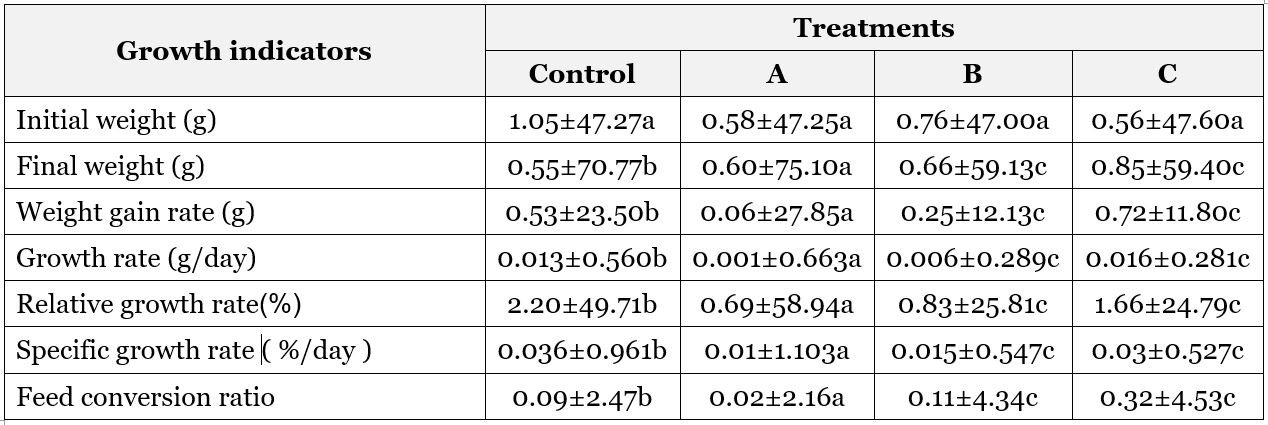
The use of alternative feeds is a modern trend in aquaculture aimed at reducing production costs and maintaining productive efficiency. This study aimed to evaluate the growth performance of Oreochromis niloticus fish when wheat flour was replaced with Suaeda aegyptiaca (salt-producing plant) powder at ratios of 0, 25, 50, and 100%. Ninety-six fish with an average initial weight of 47.28 ± 0.68 g were used. They were randomly distributed into 12 plastic tanks (30 × 30 × 60 cm) at a density of 8 fish per tank. The experiment was designed as a four-treatment system with three replicates per treatment. The fish were fed the experimental diets for 60 days at a daily feeding rate of 3% of their body weight, with adjustments made every 15 days. Statistical analysis revealed significant differences (P < 0.05) in Favor of the 25% substitution treatment in final weight, total and daily weight gain, relative and qualitative growth rates, and feed conversion ratio, compared to the other treatments. In contrast, no significant differences (P > 0.05) were observed between the 50% and 100% treatments in the studied growth indicators. The 25% treatment achieved the highest weight gain (75.10 g), the best relative (58.94%) and qualitative (1.103%/day) growth rates, and the best feed conversion efficiency (2.16). These results indicate the potential for substituting up to 25% of wheat flour with S. aegyptiaca plant powder without negatively impacting growth performance or feed conversion efficiency, thus supporting its use as an alternative feed source in Nile tilapia diets within sustainable aquaculture systems.
Metrics
References
Aboelnazr, D.I.M. (2022). Impacts of Fortifying Nile Tilapia (Oreochromis niloticus) Diet with Different Strains of Microalgae on Its Performance, Fillet Quality and Disease Resistance to Aeromonas hydrophila Considering the Interplay between Antioxidant and Inflamm. MDPI (Multidisciplinary Digital Publishing Institute).
Awad, E. and Awaad, A. (2017). Role of medicinal plants on growth performance and immune status in fish. Fish & shellfish immu, 67: 40-54.
Al-Dubakel, A.Y.; Al-Hamadany, Q.H. and Jabir, A.A. (2014). The relationship between the diet flavor and feeding sequence on the growth of common carp (Cyprinus carpio L.) fingerlings. Basrah J. Agric. Sci., (Special Issue) 26(2):130-142.
Ajani, E. K.; Orisasona, O.; Omitoyin, B.O. and Osho, E. F. (2016). Total Replacement of Fishmeal by Soybean Meal with or Without Methionine Fortification in the Diets of Nile Tilapia, Oreochromis niloticus. J. Fish, Aquat. Sci., 11: 238-243.
Alanärä, A. (1996). The use of self-feeders in rainbow trout Oncorhynchus mykiss production. Aquaculture, 145, 1–20.
Appelbaum, S. and Arockiaraj, A.J. (2009). Cultivation of gilthead sea bream (Sparus aurata Linnaeus, 1758) in low salinity inland brackish geothermal water, AACL Bioflux, 2(2):197-203.
Yesser, A.T.; Al-Faiz, A.A.; Hussein, S.A. (2014) Impact of feeding levels on growth performance and food conversion of Acanthopagrus arabicus cultivated in concrete tanks at Basrah province. Iraqi J. Aquac. 11 (2):2012: 311- 321. (In Arabic).
Bulut, M.; Yiğit, M.; Ergün, S.; Kesbiç, O.S.; Acar, U.; Karga, M. and Güroy, D. (2014). Incorporation of corn gluten meal as a replacement for fish meal in the diets of two banded seabream (Diplodus vulgaris) juveniles. Inte. J. of Agri Sci, 4(1): 60-65.
Bjørndal, T.; Dey, M. and Tusvik, A. (2024). Economic analysis of the contributions of aquaculture to future food security. Aquaculture, 578:740071
Changsu, K.; Kyoung, H.K.; Sang, Y.J. and Beob, G.K. (2021). Energy concentration and phosphorus digestibility in meat meal, fish meal, and soybean meal fed to pigs, Anim. Biosci. 34(11): 1822–1828.
Chowdhury, D.K. (2011). Optimal feeding rate for Nile tilapia (Oreochromis niloticus). M.Sc. thesis. Department of Animal and Aquacultural Sciences, Norwegian University of Life Sciences, 76 p.
Jopling, M.F. (1993). Bioenergetics feed intake and energy portioning. In. Fish ecophysiology. Rankin, J.C. and Jensen, B. (Eds).1-44 London: Chapman and Hall.
Helmiati, S and Isnansetyo, A. (2021). The replacement of fish meal with fermented Moringa leaves meal and its effect on the immune response of red tilapia (Oreochromis sp.). IOP conference series: Earth and envir sci, Vol. 919.
Hossain, M.A.; Hossain, M.A.; Haque, M.A.; Mondol, M.M.R.; Rashid, M.H. U., and Das, S. K. (2022). Determination of suitable stocking density for good aquaculture practice-based carp fattening in ponds under drought-prone areas of Bangladesh. Aquaculture 547: 737485. Doi: 10.1016/j.aquaculture.2021.737485
Hossain, M.M.; Ali, M.L.; Khan, S.; Haque, M.M., and Shahjahan, M. (2020a). Use of Asian watergrass as feed of grass carp. Aquac. Rep. 18:100434. Doi: 10.1016/j.aqrep.2020.100434
Hossain, M.M., Rahman, M.H., Ali, M.L., Khan, S., Haque, M.M., & Shahjahan, M. (2020). Development of a low-cost polyculture system utilizing Hygroryza aristata floating grass in the coastal wetlands of Bangladesh. Aquaculture, 527, 735430.
Iqbal, S.; Atique, U.; Mahboob, S.; Haider, M.S.; Iqbal, H.S., and Al-Ghanim, K.A. (2020a). Effect of supplemental selenium in fish feed boosts growth and gut enzyme activity in juvenile Tilapia (Oreochromis niloticus). J. King Saud. Univ. Sci. 32, 2610–2616.
Gallagher, M.L. (1994). The use of soybean meal as a replacement for fish meal in diets for hybrid striped bass (Morone saxatilis M. chrysops). Aquaculture, 126:119-127. Doi: 10.1016/j.jksus.2020.05.001
Karlsen, F. and Skov, P.V. (2022). Review – Potentials and limitations of DeLaurier’s spent grain as a protein source in aquaculture feeds. In J.of Clean. Prod. (Vol. 357). https://doi.org/10.1016/j.jclepro.2022.131986
Komal, S., Nuzhat, A., Ghulam, A., Abdul, M., Rafia, A. and Shahzad N (2024) Culture Trials and Biochemical analysis of Arabian yellowfin seabream Acanthopagrus arabicus Iwatsuki, 2013 to Evaluate Feed Efficacy. Jor. J of Bio. Sci. JJBS.17(4):613-621p. https://doi.org/10.54319/jjbs/170404
Mehrim, A.I.; Refaey, M.M.; Hassan, M.A.E.; Zaki, M.A. and Zenhom, O.A. (2022). As a reproductive enhancer agent for African catfish, Clarias gariepinus (Burchell,1822). Fish Phys. Biochem. 48: 15–32. Doi:10.1007/s10695-021-00969-y
Pokorný, J. and Froněk, P. (2021). Price Forecasting Accuracy of the OECDFAO's Agricultural Outlook and the European Commission DG AGRI's Medium-Term Agricultural Outlook Report. AGRIS on-line Papers in Economics and Informatics, 13(3), 77-87
Prodhan, M.M.H., and Khan, M.A. (2018). Management practice adoption and productivity of commercial aquaculture farmsin selected areas of Bangladesh. J. Bangl. Agri. Uni. 16, 111–116. Doi: 10.3329/jbau. V16i1.36491
Pu, H.; Li, X.; Du, Q.; Cui, H. and Xu, Y. (2017). Research progress in the application of Chinese herbal medicines in aquaculture: a review. Engineering. 3(5): 731–737. Doi: 10.1016/J.ENG.2017.03.01735609759
Russell, A.J.; Rowland, S.J. and McMeniman, N.P. (1996). Effects of feeding level and frequency on growth and food conversion ratio of juvenile silver perch (Bidyanus bidyanus). Proc. Aust. Soc. Anim. Prod., 21: 370
Salama, A.J. and Al-Harbi, M.A. (2007). Response of the Asian Sea bass Lates calcarifer fingerlings to different feeding rates and feeding frequencies reared in hyper saline condition, JKAU: Mar. Sci., 18: 63-81.
Muhammed, S.J. (2024) Effects of Four Imported Floating Diets on Feed Intake and Daily Feeding Rate of Grass Carp, Ctenopharyngodon della (Valenciennes, 1844). Thi- Q ar J. of agric. res.13(1):291-297p.
SPSS, (2000). SPSS for windows base system users guide, release 10.0 Chicago, USA.
A.O.A.C. (Association of Official Analytic Chemists). (2005). Official Methods of Analysis AOAC, Washington DC, 1963 pp.
Sogbesan, O.A. (2006). Effects of different organic substrates on growth and survival of long winged termite (Macrotermes subhyabrius) under laboratory conditions. Afr. J. of Gen. Agric., 2(2):3744.
Talpur, M.A.D.; Ikhwanuddin, M. and Abol-Munafi, A.B. (2013). Nutritional effects of ginger (Zingiber officinale Roscoe) on immune response of Asian sea bass, Lates calcarifer (Bloch) and disease resistance against vibrio harvei. Aguacultu, 400-401:46-52.
Tiwari, M.R. and Dhaka, H.R. (2021). Bakery waste is an alternative of maize to reduce the cost of pork production. Nep. J. Agric. Sci., 20: 28-40
Taher, M.M; Al-Dubaikel, A.Y and Saleh, J.H (2014). Effect of feeding ratio on growth and feed conversion ratio of common carp (Cyprinus carpio) raised in floating cages. Iraqi J. of Aquac.11(1):15-26.
Wee, W.; Hamid, N.K.A.; Mat, K.; Khalif, R.I.A.R.; Rusli, N.D.; Rahman, M.M. & Wei, L. S. (2022). The effects of mixed prebiotics in aquaculture: A review. Aquac and Fisher. 9 (1):28-34.
Wong, M.-H.; Mo, W.-Y.; Choi, W.-M.; Cheng, Z. and Man, Y.-B. (2016). Recycle food wastes into high quality fish feeds for safe and quality fish production. Environ. Pollut., 219: 6
Downloads
Published
How to Cite
Issue
Section
License
Copyright (c) 2026 Iraqi Journal of Aquaculture

This work is licensed under a Creative Commons Attribution 4.0 International License.