Micropropagation of lemongrass Cymbopogon citratus L. and evaluation the effectiveness of methanolic leaves extract and its antibacterial activity in inhibiting three species of bacteria that cause bacterial gill disease in common carp fish
Inhibiting three species of bacteria that cause bacterial gill disease in common carp fish
Keywords:
lemongrass, Micropropagation, Phytochemical, methanolic leaves extract, antibacterial activityAbstract
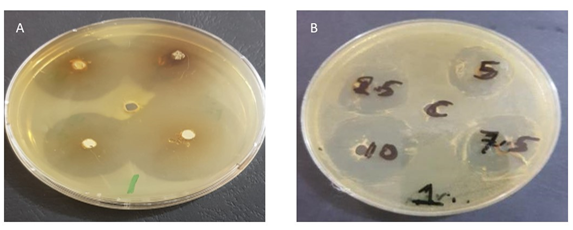
The current study was conducted in the laboratories of the Marine Science Center at the University of Basrah. In order to propagate lemongrass using plant tissue culture technology and test the effectiveness of leaves methanolic extract in concentrations (2.5%, 5%, 7.5%, and 10%), to demonstrate its effect in inhibiting three species of bacteria (Aeromonas sobria, Sphingomonas paucimobilis, and Sphingomonas paucimobilis Isolated from common carp (Cyprinus carpio) infected with bacterial gill disease, The bacterial types were collected from infected fish at a local fish farm in Basrah Governorate, southern Iraq, The bacterial isolates were identified chemically using VITEK II system cards, as well as genetically using 16s rRNA. The results showed that the 10% extract exhibited the highest antibacterial efficacy, while the 2.5% concentration showed the weakest activity. Notably, Aeromonas sobria strain demonstrated the greatest sensitivity to the lemongrass extract, whereas Sphingomonas paucimobilis showed complete resistance across all tested concentrations. The results of GC MS analysis indicated that the lemongrass extract contained many active compounds, including Itaconate and Eugenol, which have an antibacterial effect, Citral, Curlone, hydrazine, saponin, and all concentrations of the extracts showed varying degrees of activity against these tested bacterial species, comparable to their effectiveness with the standard antibiotic oxytetracycline.
Metrics
References
Abbott, S.L.; Cheung, W.K., and Janda, J.M. (2003). The genus Aeromonas: Biochemical characteristics, atypical reactions, and phenotypic identification schemes. J. Clin. Microbiol., 41, 2348–2357.
Alara, O.R.; Abdurahman, N.H., and Ukaegbu, C.I. (2021). Extraction of phenolic compounds: A review. Curr Res food Sci, 4, 200-214.
AL-Arady, H.J.; Saleh, A.M.; Khaun A.M., and Al-Zewar, J.M. (2017). Propagation of water hyssop (Bacopa monnieri) in vitro. Iraqi Journal of Aquaculture, 14(1): 1-12.
Bard, M.; Albrecht, M.R.; Gupta, N.; Guynn, C.J., and Stillwell, W. (1988). Geraniol interferes with membrane functions in strains of Candida and Saccharomyces. Lipids., 23, 534–538.
Burke, Y.D.; Stark, M.J.; Roach, S.L.; Sen, S.E., and Crowell, P.L. (1997). Inhibition of pancreatic cancer growth by the dietary isoprenoids farnesol and geraniol. Lipids .32, 151–156.
Cantrell, C.L., Franzblau, S.G., and Fischer, N.H. (2001). Antimycobacterial plant terpenoids. Planta medica, 67(08): 685-694.
Chowdhary, P., Ranjan, R., Pandey, A andKumar, R. (2016). Sphingomonas paucimobilis septicemia in a neonate: Arare case report. Indian J. Pathol Microbiol,.59(1): 119.
Damasceno, R.O.S., Pinheiro, J.L.S., Rodrigues, L.H.M., Gomes, R.C., Duarte, A.B.S., Emídio, J.J., Diniz, L.R.L., and de Sousa, D.P. (2024). Anti-Inflammatory and Antioxidant Activities of Eugenol: An Update. Pharmaceuticals, 17(11), 1505.
De Silva, B.C.J., Jung, W.G., Hossain, S., Wimalasena, S.H.M.P., Pathirana, H.N.K.S., and Heo, G.J. (2017). Antimicrobial property of lemongrass (Cymbopogon citratus) oil against pathogenic bacteria isolated from pet turtles. Lab. Anim. Res., 33, 84-91.
https://doi.org/10.1016/j.foodchem.2021.131918
Gao, S.; Liu, G.; Li, J.; Chen, J.; Li, L.; Li, Z.; Zhang, X.; Zhang, S.; Thorne, R.F. and Zhang, S. (2020) Antimicrobial Activity of Lemongrass Essential Oil (Cymbopogon flexuosus) and Its Active Component Citral Against Dual-Species Biofilms of Staphylococcus aureus and Candida Species. Front. Cell. Infect. Microbiol. 10:603858.
Gonzalez-Rivera, M.L.; Barragan-Galvez, J.C.; Gasca-Martínez, D.; Hidalgo-Figueroa, S.; Isiordia-Espinoza, M., & Alonso-Castro, A.J. (2023). In vivo neuropharmacological effects of neophytadiene. Molecules, 28(8): 3457.
Hajam, Y.A.; Kumar, R.; Rani, R and Sharma, P. (2022). Efficacy of different treatments available against bacterialpathogens in fish. In Bacterial Fish Diseases (pp. 379-398). Academic Press
Inouye, S., Takizawa, T., and Yamaguchi, H. (2001) Antibacterial activity of essential oils and their major constituents against respiratory tract pathogens by gaseous contact. J Antimicrob Chemother, 47, 565–573.
Iorizzo, M.; Albanese, G.; Letizia, F.; Testa, B.; Tremonte, P.; Vergalito, F and Sorrentino, E. (2022). Probiotic potentiality from versatile Lactiobacillus plantarum strains as resource to enhance freshwater fish health. Microorg, 10(2): 463.
Islam, M.T.; de Alencar, M.V.O.B.; da Conceição Machado, K.; da Conceição Machado, K.; de Carvalho Melo-Cavalcante, A.A., de Sousa, D.P., and de Freitas, R.M. (2015). Phytol in a pharma-medico-stance. Chem-Biol Interact, 240, 60-73.
Islam, M.T.; Ayatollahi, S.A.; Zihad, S.N.K.; Sifat, N.; Khan, M.R.; Paul, A., and Sharifi-Rad, J. (2020). Phytol anti-inflammatory activity: Pre-clinical assessment and possible mechanism of action elucidation. Cell Mol. Biol., 66(4): 264-269.
Jassim, A.A.R.; Al- Imara, E.A.; Ahmed, A.R., and Hammood, A.Y. (2026). Isolation and Molecular Identification of Bacterial Gills Pathogen Isolated from Cultured Common Carp Cyprinus carpio (L.) in Earthen Ponds in Basrah Governorate, Iraq. Basrah J. Agric. Sci., 38(2): 103–112.
Kulus, D., and Miler, N. (2021). Application of plant extracts in micropropagation and cryopreservation of bleeding heart: An ornamental-medicinal plant species. Agric, 11(6), 542..https://doi.org/10.3390/agriculture11060542
Liu, Y.; Yang, L.; Zu, Y.; Zhao, J.; Zhang, Y.; Zhang, Z., and Wang, W. (2012). Development of an ILMS method for simultaneous extraction and distillation for determination of proanthocyanidins and essential oil in Cortex cinnamomi. J Food Chem, 135, 2514-2521.
Myriama, M.; Kthiri, Z.; Ben Jabeur, M., and Hamada, W. (2018). Ethnobotanical and phytopharmacological notes on Cymbopogon citratus (DC.) Stapf, J new sci,.55(5):3642-3652.
Mailafia, S.; Nabilah, B., and Olabode, H.O.K. (2021). Phenotypic Characterization of Aeromonas hydrophila Isolates in Fresh Water Fishes in FCT Using MicrobactTM GNB 24E Identification Kit. Open Access Library J, 8, 1-12.
Mandalakis, M.; Anastasiou, T.I.; Martou, N.; Keisaris, S.; Greveniotis, V.; Katharios, P., and Antonopoulou, E. (2021). Antibacterial effects of essential oils of seven medicinal-aromatic plants against the fish pathogen Aeromonas veronii bv. sobria: to blend or not to blend? Molecules, 26(9): 2731.
Marya, C.M. (2022). Antibacterial efficacy of lemongrass (Cymbopogon citratus) extract against S. mutans. Ann. Med. Health Sci. Res, 12, 1-5.
Mohammed, T.K.; Aqel, N., and Al-Dujaili, E. A. (2020). Antimicrobial activity of liquid residues of Cymbopogon citratus oil extracts. In J of Phys: Conference Series (Vol. 1660, No. 1, p. 012006. IOP Publishing.
Murashige, T., and Skoog, F. (1962). A revised medium for rapid growth and bio assays with tobacco tissue cultures. Physiologia plantarum, 15(3) 473-497
https://doi.org/10.1111/j.1399-3054.1962.tb08052.x.
Myriama, M.; Zayneb, K., and Walid, H. (2018). Chemical composition of Cymbopogon citratus (DC.) Stapf essential oil and evaluation of its antifungal activities against phytopathogenic fungi. Transylvanian Rev. 26(30).
Naik, M.I.; Fomda, B.A.; Jaykumar, E., and Bhat, J.A. (2010). Antibacterial activity of lemongrass (Cymbopogon citratus) oil against some selected pathogenic bacteria. Asian pac. J. Trop. Med., 3(7), 535-538.
Nambiar V.S., and Matela, H. (2012). Potential functions of lemon grass (Cymbopogon citratus) in health and disease. Int. J. Pharmaceut. Biol. Arch3: 1035-1043.
Naqqash, Z.A.A., and Al-Bazaz, H.K. (2019). GC-Mass and phytochemical investigation of Cymbopogon citratus. Res. J. Pharm Technol, 12(1), 67-73.
Narvaez, P.; Vaughan, D.B.; Grutter, A.S., and Hutson, K.S. (2021). New perspectives on the role of cleaning symbiosis in the possible transmission of fish diseases. Reviews in Fish Biology and Fisheries, 31(2), 233-251.
NIST, N. (2014). EPA/NIH mass spectral library. National Institute of Standards and Technology, Gaithersburg.
NCCLS 1993. Performance Standard for Antimicrobial Disc Susceptibility Tests. Approved Standard. Publication M2-A5. Villanova, PA: NCCLS.
Noga, E.J. (2010). Fish disease: diagnosis and treatment. John Wiley & Sons.
Oh, S.; Han, A.R.; Park, H.R.; Jang, E.J.; Kim, H.K.; Jeong, M.G., and Hwang, E.S. (2014). Suppression of inflammatory cytokine production by ar‐turmerone isolated from Curcuma phaeocaulis. Chem & Biodiver, 11(7), 1034-1041.
Pathirana, H.N.K.S.; Wimalasena, S.H.M.P., De Silva, B.C.J., Hossain, S., and Gang-Joon, H. (2019). Determination of the in vitro effect of lemongrass (Cymbopogon flexuosus) oil against fish pathogenic bacteria isolated from cultured olive flounder (Paralichthys olivaceus). Slov. Vet. Res, 56, 125-131.
Park, S.H., Kim, D.S., Kim, S., Lorz, L.R., Choi, E., Lim, H.Y., and Cho, J.Y. (2019). Loliolide presents antiapoptosis and antiscratching effects in human keratinocytes. Inter j mol sci, 20(3), 651.
Raina, J.; Firdous, A.; Singh, G.; Kumar, R., and Kaur, C. (2024). Role of polyphenols in the management of diabetic complications. Phytomedicine, 122, 155155.
Sato, K.; Krist, S., and Buchbauer, G. (2007). Antimicrobial effect of vapours of geraniol,(R)‐(–)‐linalool, terpineol, γ‐terpinene and 1, 8‐cineole on airborne microbes using an airwasher. Flavour Frag J, 22(5), 435-437.
Shendurse, A.M., Sangwan, R.B., Kumar, A., Ramesh, V., Patel, A.C., Gopikrishna, G., and Roy, S.K. (2021). Phytochemical screening and antibacterial activity of lemongrass (Cymbopogon citratus) leaves essential oil. J Pharmacognosy Phytochem, 10(2), 445-449.
Rajeswari Shome, R.S.; Shome, B.R.; Mazumder, Y.; Das, A.; Kumar, A.; Rahman, H., and Bujarbaruah, K.M. (2005). Abdominal dropsy disease in major carps of Meghalaya: isolation and characterization of Aeromonas hydrophila. Cur. Sci. 88 (12) 1897-1900.
Si, W.; Gong, J.; Tsao, R.; Zhou, T.; Yu, H.; Poppe, C., and Du, Z. (2006). Antimicrobial activity of essential oils and structurally related synthetic food additives towards selected pathogenic and beneficial gut bacteria. J Appl Microbiol, 100(2), 296-305.
Suzanne, G.Y.; Hildebrandt, L.A., and Elson, C.E. (1995). Geraniol, an inhibitor of mevalonate biosynthesis, suppresses the growth of hepatomas and melanomas transplanted to rats and mice., J. nutr., 125(11), 2763-2767.
Thomas, B. (2016). Encyclopedia of applied plant sciences. Academic Press. ISO 690 "UK Misuse of Drugs act 2001 Amendment summary". Isomer Design. Archived from the original on 22 October 2017. Retrieved 12 March 2014.
Wickramanayake, M.V.K.S.; Kumarage, P.M.; Majeed, S., and Heo, G.J. (2023). An overview of the antimicrobial activity of some essential oils against fish pathogenic bacteria: https://doi. org/10.12982/VIS. 2023.009. Vet. Integr. Sci., 21(1), 99-119.
Yu, S.G., Anderson, P.J., and Elson, C.E. (1995). Efficacy of. beta.-Ionone in the chemoprevention of rat mammary carcinogenesis. J. Agric. Food Chem., 43(8), 2144-2147.
Zaheen, Z.; War, A.F.; Ali, S.; Yatoo, A.M.; Ali, M.N.; Ahmad, S.B.; Rehman, M.U., and Paray, B.A. (2022). Common bacterial infections affecting freshwater fish fauna and impact of pollution and water quality characteristics on bacterial pathogenicity. Bacterial Fish Diseases, 133-154.
Downloads
Published
How to Cite
Issue
Section
License
Copyright (c) 2026 Iraqi Journal of Aquaculture

This work is licensed under a Creative Commons Attribution 4.0 International License.