Preliminary Assessment of Mitochondrial Genetic Diversity in Epinephelus spp. from Iraqi Marine Waters of the Arabian Gulf
Keywords:
Epinephelus spp., genetic diversity, mitochondrial DNA, Arabian Gulf, Iraqi marine watersAbstract
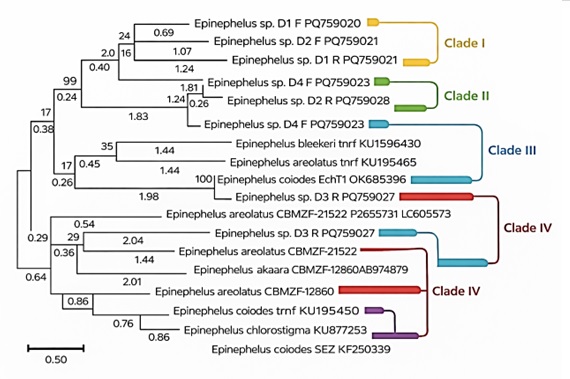
The Arabian Gulf is an exceptional marine ecosystem subject to a range of harsh environmental conditions that can influence the genetic makeup of marine organisms. Grouper species of the genus Epinephelus are of ecological and economic importance in this ecosystem. Genetic studies of these species in the Iraqi marine environment are limited. This study presents a preliminary approach to estimating mitochondrial genetic diversity in Epinephelus species. DNA was extracted and sequenced, focusing on the mitochondrial control region (D-loop) adjacent to tRNA-Phe and a portion of 12S rRNA. Analysis of mitochondrial gene spacing (D-loop, tRNA-Phe, and 12S rRNA) revealed two distinct groups of Epinephelus species. Each group was characterized by short internode lengths and high sequence similarity. The groups were separated by intermediate gene spacing, and the high branch support values in the hierarchical tree indicated weak differentiation at the species level. This clustering analysis served as a graphical tool for revealing mitochondrial structure within a single species. Mitochondrial sequences revealed two genetically distinct clusters, indicating population genetic structure rather than species divergence. This genetic divergence may be due to local environmental conditions, geographic isolation, and reduced gene flow in grouper (Epinephelus) species in the Iraqi Arabian Gulf. This study provides preliminary mitochondrial genetic information for grouper species in the Iraqi region of the Arabian Gulf.
Metrics
References
Avise, J.C. (2000). Phylogeography: The History and Formation of Species. Harvard University Press, Cambridge, Massachusetts.
Burt, J.A.; Feary, D.A.; Bauman, A.G. and Usseglio, P. (2011). Climate change adaptation in corals: The role of phenotypic plasticity. Mar. Pollut. Bull., 62(10): 1981–1987. https://doi.org/10.1016/j.marpolbul.2011.02.017
Coleman, F.C.; Koenig, C.C. and Huntsman, G.R. (2016). Integrating genetic and ecological data for marine fish management. Fish Fish., 17(1): 123–142.
https://doi.org/10.1111/faf.12101
Craig, M.T.; Hastings, P.A. and Pondella, D.J. (2001). Speciation in the Central Eastern Pacific: Phylogenetic relationships among gobies of the genus Coryphopterus. Copeia., 2001(4): 798–804.
Gaither, M.R.; Bowen, B.W.; Rocha, L.A. and Toonen, R.J. (2018). Biogeographic barriers and dispersal in reef fishes. Natu. Eco. & Evol., 2, 157–166.
https://doi.org/10.1038/s41559-017-0415-8
Hebert, P.D.N.; Cywinska, A.; Ball, S.L. and deWaard, J.R. (2003). Biological identifications through DNA barcodes. Proceed. of the Roy. Socie. B. Bio. Sci., 270(1512): 313–321.
https://doi.org/10.1098/rspb.2002.2218
Lakra, W.S.; Goswami, M.; Gopalakrishnan, A.; Lal, K.K.; Mohindra, V.; Punia, P.; Singh, K.V. and Ward, R.D. (2015). DNA barcoding Indian marine fishes. Mitoch. DNA Part A, 26(1): 1–13. https://doi.org/10.3109/19401736.2013.842292
Mabuchi, K.; Nakabo, T. and Nishida, M. (2004). Phylogenetic relationships of groupers (Perciformes: Serranidae: Epinephelinae) inferred from mitochondrial DNA sequences. J. Fish Biol., 64(4): 767–780.
https://doi.org/10.1111/j.1095-8649.2004.00350.x
Palsbøll, P.J.; Bérubé, M. and Allendorf, F.W. (2007). Identification of management units using population genetic data. Trends Ecol. Evol., 22(1): 11–16.
https://doi.org/10.1016/j.tree.2006.09.003
Sadovy de Mitcheson, Y. and Liu, M. (2008). Functional hermaphroditism in teleosts. Fish and Fish., 9(1): 1–43. https://doi.org/10.1111/j.1467-2979.2007.00266.x
Sadovy de Mitcheson, Y.; Craig, M.T.; Bertoncini, A.A.; Carpenter, K.E., Cheung, W.W.L.; Choat, J.H.; Cornish, A.S.; Fennessy, S.T.; Ferreira, B.P.; Heemstra, P.C.; Liu, M.; Myers, R.F.; Pollard, D.A.; Rhodes, K.L.; Rocha, L.A.; Russell, B.C.; Samoilys, M.A. and Sanciangco, J. (2013). Fishing groupers towards extinction: A global assessment of threats and extinction risks in a billion-dollar fishery. Fish and Fish., 14(2): 119–136.
https://doi.org/10.1111/j.1467-2979.2011.00455.x
Sheppard, C.; Al-Husiani, M.; Al-Jamali, F.; Al-Yamani, F.; Baldwin, R.; Bishop, J.; Benzoni, F.; Dutrieux, E.; Dulvy, N.K.; Durvasula, S.R.V.; Jones, D.A.; Loughland, R.; Medio, D.; Nithyanandan, M.; Pilling, G.M.; Polikarpov, I.; Price, A.R.G.; Purkis, S.; Riegl, B.; Saburova, M.; Namin, K.S.; Taylor, O.; Wilson, S. and Zainal, K. (2010). The Gulf: A young sea in decline. Mar. Pollut. Bull., 60(1): 13–38.
https://doi.org/10.1016/j.marpolbul.2009.10.017
Ward, R.D.; Zemlak, T.S.; Innes, B.H.; Last, P.R. and Hebert, P.D.N. (2005). DNA barcoding Australia's fish species. Philosophical Transactions of the Royal Society B: Biol. Sci., 360(1462): 1847–1857.
https://doi.org/10.1098/rstb.2005.1716
Wang, Z.; Liu, J.; Chen, X. and Li, S. (2020). Mitochondrial genome variation and population differentiation in marine fishes. Mar. Gen., 53, 100768.
Downloads
Published
How to Cite
Issue
Section
License
Copyright (c) 2026 Iraqi Journal of Aquaculture

This work is licensed under a Creative Commons Attribution 4.0 International License.