Pomegranate Peel Powder as a Natural Preservative Enhances the Microbiological Quality, Oxidative Stability and Shelf-Life of Aquafeed During Ambient Storage
Keywords:
Fish diets, Pomegranate peel, Shelf life, Aspergillus spp.Abstract
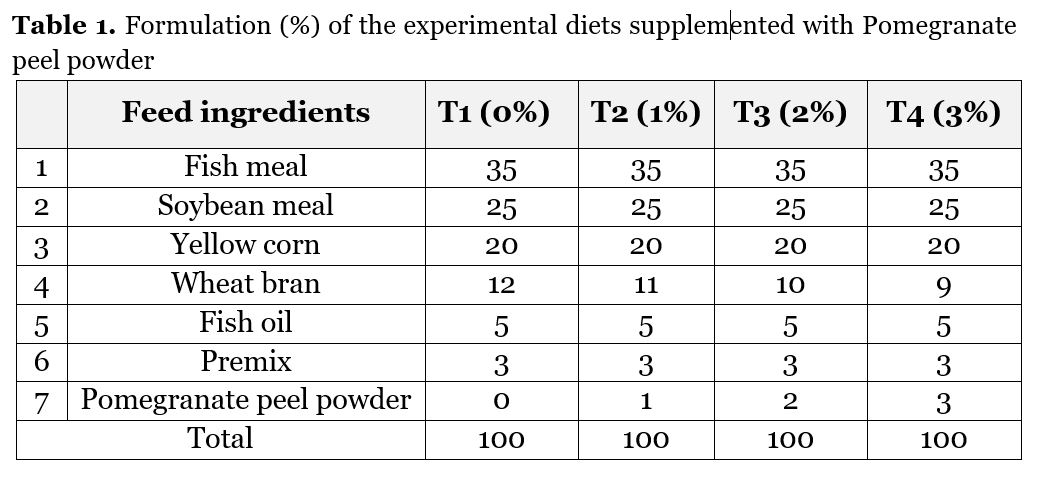
This study was conducted at the Aquaculture Unit, College of Agriculture, University of Basrah, to evaluate the effect of dietary pomegranate peel powder (PPP) supplementation 0, 10, 20, and 30 g/kg feed treatments (T1–T4) on the microbiological quality and shelf-life of fish feed stored at ambient temperature (25 ± 2°C) for eight weeks. Results showed that total bacterial count in the control (T1) increased from 0.12 × 10³ to 9.8 × 10⁴ CFU/g by week 8, while T4 remained as low as 2.1 × 10³ CFU/g; mold and yeast counts decreased from 3.2 × 10³ CFU/g (T1) to 4.3 × 10¹ CFU/g (T4), a reduction exceeding 99% and coliform bacteria, detected in T1 from week 3 and reaching 14.00 × 10² CFU/g by week 8, remained below detection in T4 until week 4 and never exceeded 0.05 × 10² CFU/g. Regarding oxidative deterioration, free fatty acid content rose to 4.87 ± 0.18% in T1-surpassing the 4.0% EFSA/FAO limit, while T4 maintained a significantly lower value of 1.80 ± 0.08%, 63% reduction; similarly, TBA values increased from 0.25 to 3.21 ± 0.12 mg MDA/kg in T1, exceeding the 3.0 mg/kg acceptable limit, whereas T4 stayed at 0.74 ± 0.03 mg MDA/kg, a ~77% reduction relative to control. Overall, dietary supplementation with 20–30 g/kg pomegranate peel powder effectively improved the microbiological quality and oxidative stability of aquafeeds during storage, supporting its potential as an economical, sustainable, and environmentally friendly natural preservative that could replace synthetic preservatives in aquafeed formulations.
Metrics
References
Abdel-Tawwab, M.; Mousa, M.A.; Mamoon, A.; Abdelghany, M.F.; Abdel-Hamid, E.A.; Abdel-Razek, N.; Ali, F.S.; Shady, S.H. and Gewida, A.G. (2022). Dietary Chlorella vulgaris modulates the performance, antioxidant capacity, innate immunity, and disease resistance capability of Nile tilapia fingerlings fed on plant-based diets. Anim. Feed Sci. Technol., 283, 115181. DOI:10.1016/j.anifeedsci.2021.115181.
Albadran, M.A.; Najim, S.M. and Al-Niaeem, K.S. (2018). Effect of dietary prebiotic vegetable wastes on serum biochemical parameters and intestinal microflora of juvenile common carp Cyprinus carpio. Biol. Appl. Environ. Res., 2 (2): 162 – 170.
Al-Noor, J.M. (2024). The Effect of Different Thermal Treatments on The Chemical Composition and Amino and Fatty Acids Profiles in Fish Artificial Diets. Mesopot. J. Mar. Sci., 39 (2):173 – 184. DOI: https://doi.org/10.58629/mjms.v39i2.379.
Al-Noor, J.M. and Al-Waely, W.A. (2024). Microbiological and Quality Assessment of Commonly Used Fish Diets from Basrah, Iraq. Egypt. J. Aquat. Biol. Fish., 28 (5): 2107 – 2126. DOI: 10.21608/EJABF.2024.389796.
Al-Noor, J.M.; Najim, S.M. and Al-Tameemi, R.A. (2023). Detection and Levels of Some Mycotoxins and Biogenic Amines in Fish Diets and Feed Ingredients from Basrah, Iraq. Egypt. J. Aquat. Biol. Fish., 27 (4): 997 – 1012.
Al-Noor, J.M.; Najim, S.M. and Al-Tameemi, R.A. (2025). Evaluation of the effects of garlic powder and oil on growth performance and physiological parameters of common carp (Cyprinus carpio L.) Iraqi J. Aquacult. 22 (1): 187 – 202. DOI: https://doi.org/10.58629/ijaq.v22i1.686.
AOAC International (2019). Official Methods of Analysis of AOAC International (21st ed.). Rockville, MD: AOAC International.
APHA (American Public Health Association) (2017). Standard Methods for the Examination of Water and Wastewater (23rd ed.). Washington, DC: APHA Press.
Araújo, J.M.S. and de Aquino Santana, L.L. (2018). Predictive modelling of foodborne bacteria inhibition by pomegranate (Punica granatum L.) peel extracts using response surface methodology. Qual. Assur. Saf. Crops Foods, 10 (2): 137 – 144.
Aviram, M.; Dornfeld, L.; Rosenblat, M.; Volkova, N.; Kaplan, M.; Coleman, R. and Fuhrman, B. (2000). Pomegranate juice consumption reduces oxidative stress, atherogenic modifications to LDL, and platelet aggregation. Am. J. Clin. Nutr., 71 (5): 1062 – 1076. DOI: 10.1093/ajcn/71.5.1062.
Bakkiyaraj, D.; Nandhini, J.R.; Malathy, B. and Pandian, S.K. (2013). The anti-biofilm potential of pomegranate (Punica granatum L.) extract against human bacterial and fungal pathogens. Biofouling, 29 (8): 929–937.
DOI: 10.1080/08927014.2013.820825
Bondad-Reantaso, M.G.; Subasinghe, R.P.; Arthur, J.R.; Ogawa, K.; Chinabut, S.; Adlard, R. and Shariff, M. (2005). Disease and health management in Asian aquaculture. Vet. Parasitol., 132 (3 – 4): 249–272.
DOI: 10.1016/j.vetpar.2005.07.005.
Çam, M.; Hışıl, Y. and Durmaz, G. (2009). Classification of eight pomegranate juices based on antioxidant capacity measured by four methods. Food Chem., 112 (3): 721–726. DOI:10.1016/j.foodchem.2008.06.009.
Camarda, L.; Budriesi, R.; Corazza, I.; Frosini, M.; Marzetti, C. and Mattioli, L.B. (2026). Antioxidant and Health-Related Effects of Tannins: From Agri-Food By-Products to Human and Animal Health. Antioxidants, 15 (1): 104.
Chen, J.; Liao, C.; Ouyang, X.; Kahramanoğlu, I.; Gan, Y. and Li M. (2020). Antimicrobial activity of pomegranate peel and its applications on food preservation. J. Food Qual., 2020 (1): 8850339.
Daglia, M. (2012). Polyphenols as antimicrobial agents. Curr. Opin. Biotechnol., 23 (2): 174–181. DOI: 10.1016/j.copbio.2011.08.007.
De Leon, J.A.D. and Borges, C.R. (2020). Evaluation of oxidative stress in biological samples using the thiobarbituric acid reactive substances assay. J. Vis. Exp., (159): e61122.
Dogra, A. and Gandotra, R. (2024). Effect of pomegranate peel extract on biochemical and microbial changes in Labeo rohita during chilled storage. Proc. Natl. Acad. Sci., India, Sect. B Biol. Sci., 94 (2): 397–405.DOI:10.1007/s40011-023-01537-5.
Esterbauer, H.; Schaur, R.J. and Zollner, H. (1991). Chemistry and biochemistry of 4-hydroxynonenal, malonaldehyde and related aldehydes. Free Radic. Biol. Med., 11(1): 81–128. doi: 10.1016/0891-5849(91)90192-6.
FAO(Food and Agriculture Organization of the United Nations) (2010). Responsible Use of Antibiotics in Aquaculture. FAO Fisheries Technical Paper No. 469. Rome: FAO.
FAO (Food and Agriculture Organization of the United Nations) (2022). The State of World Fisheries and Aquaculture 2022: Towards Blue Transformation. Rome: FAO.
Geng, L., Liu, K., and Zhang, H. (2023). Lipid oxidation in foods and its implications on proteins. Frontiers in Nutrition, 10, 1192199.
Ghasemi-Sadabadi, M.; Ebrahimnezhad, Y.; Maheri-Sis, N.; Shaddel-Teli, A.; Ghalehkandi, J. G. and Veldkamp, T. (2022). Effects of supplementation of pomegranate processing by-products and waste cooking oils as alternative feed resources in broiler nutrition. Sci. Rep., 12 (1): 21216. DOI: 10.1038/s41598-022-25761-7.
Hernández-Contreras, Á.; Teles, A., Salas-Leiva, J.S.; Chaves-Pozo, E. and Tovar-Ramírez, D. (2023). Feed additives in aquaculture. In Sustainable use of feed additives in livestock: novel ways for animal production. Cham: Springer Int. Publ., 811–846.
Hu, X.; Ma, W.; Zhang, D.; Tian, Z.; Yang, Y.; Huang, Y. and Hong, Y. (2025). Application of natural antioxidants as feed additives in aquaculture: A review. Biology, 14 (1): 87. https://doi.org/10.3390/biology14010087.
Khanzadeh, M.; Farhadi, A. and Jeffs, A.G. (2025). Ellagic Acid and Pomegranate (Punica granatum) Peel Powder Enhances Growth and Health Performance in Nile Tilapia (Oreochromis niloticus). Aquac. Nutr., 2025 (1): 4057455.
Kupnik, K.; Primožič, M.; Vasić, K., Knez, Ž. and Leitgeb, M. (2021). A comprehensive study of the antibacterial activity of bioactive juice and extracts from pomegranate (Punica granatum L.) peels and seeds. Plants, 10 (8): 1554.
Liu, C.; Wang, N.; Zhang, Y.Y.; Qu, H.T.; Liu, L.X.; Zhang, L.H. and Liu, Y. G. (2025). Pomegranate: historical origins, nutritional composition, health functions and processing development research. Crit. Rev. Food Sci. Nutr., 65 (33): 8447–8469. DOI: 10.1080/10408398.2025.2500676.
Magan, N. and Aldred, D. (2007). Post-harvest control strategies: minimizing mycotoxins in the food chain. Int. J. Food Microbiol., 119 (1–2): 131–139. DOI: 10.1016/j.ijfoodmicro.2007.07.034
Mihaylova, R.; Elincheva, V.; Momekov, G. and Simeonova, R. (2025). Unlocking the therapeutic potential of ellagitannins: A comprehensive review of key representatives. Molecules, 30 (22): 4328.
Mitsagga, C.; Petrotos, K. and Giavasis, I. (2021). Antimicrobial properties of lyophilized extracts of olive fruit, pomegranate and orange peel extracts against foodborne pathogenic and spoilage bacteria and fungi in vitro and in food matrices. Molecules, 26 (22): 7038.
Najim, S.M. and Al-Noor, J.M. (2026). Fermentation of Soybean Meal to Improve Diet Formulation for Common Carp Cyprinus carpio L. Iraqi J. Aquac., 23 (1): 99–115. https://orcid.org/0000-0002-5148-4186.
Naseer, S.; Hussain, S.; Naeem, N.; Pervaiz, M. and Rahman, M. (2018). The phytochemistry and medicinal value of Punica granatum (guava). Clin. Phytosci., 4 (32): 1–8. https://doi.org/10.1186/s40816-018-0093-8.
Rosas‐Burgos, E.C.; Burgos‐Hernández, A.; Noguera‐Artiaga, L.; Kačániová, M.; Hernández‐García, F.; Cárdenas‐López, J.L. and Carbonell‐Barrachina, Á.A. (2017). Antimicrobial activity of pomegranate peel extracts as affected by cultivar. J. Sci. Food Agric., 97 (3): 802–810.
Salman, N.A.; Saleh, K.I. and Taher, M.M. (2022). Cage culture in Iraq, current status and potential: A Review. Basrah J. Agric. Sci., 35 (2): 362–372. https://doi.org/10.37077/25200860.2022.35.2.27.
Sweidan, N.; Abu Rayyan, W.; Mahmoud, I. and Ali, L. (2023). Phytochemical analysis, antioxidant, and antimicrobial activities of Jordanian Pomegranate peels. Plos one, 18 (11): e0295 129.
https://doi.org/10.1371/journal.pone.0295129.
Tacon, A. G. and Metian, M. (2008). Global overview on the use of fish meal and fish oil in industrially compounded aquafeeds: Trends and future prospects. Aquaculture, 285 (1): 146 –158.
DOI:10.1016/j.aquaculture.2008.08.015
Taguri, T.; Tanaka, T. and Kouno, I. (2006). Antibacterial spectrum of plant polyphenols and extracts depending upon hydroxyphenyl structure. Biol. Pharm. Bull., 29 (11): 2226–2235.DOI: 10.1248/bpb.29.2226.
Topuz, O.K.; Yerlikaya, P.; Ucak, I.; Gümüş, B.; Büyükbenli, H.A. and Gökoğlu, N. (2015). Influence of pomegranate peel (Punica granatum) extract on lipid oxidation in anchovy fish oil under heat accelerated conditions. J. Food Sci. Technol., 52 (1): 625 – 632.
Tran, T.M.; Atanasova, V.; Tardif, C. and Richard-Forget, F. (2023). Stilbenoids as promising natural product-based solutions in a race against mycotoxigenic fungi: a comprehensive review. J. Agric. Food Chem., 71 (13): 5075 – 5092.
Vučina, R., Drmač, D., Rezić, V., Čulum, D., and Kondža, M. (2026). Enzyme Inhibition by Bioactive Compounds from Olive (Olea europaea L.) and Pomegranate (Punica granatum L.): Systematic Review of In Vitro Studies. Molecules, 31(12): 2134.
Youssef, N.H.; Qari, S.H.; Matar, S.; Hamad, N.A.; Dessoky, E.S.; Elshaer, M.M.; Sobhy, S.; Abdelkhalek, A.; Zakaria, H.M. and Heflish, A.A. (2021). Licorice, Doum, and Banana Peel Extracts Inhibit Aspergillus flavus Growth and Suppress Metabolic Pathway of Aflatoxin B1 Production. Agronomy, 11 (8): 1587.
DOI:10.3390/agronomy11081587
Downloads
Published
How to Cite
Issue
Section
License
Copyright (c) 2026 Iraqi Journal of Aquaculture

This work is licensed under a Creative Commons Attribution 4.0 International License.