Phytoremediation of water contaminated with Copper and cadmium Using Ceratophyllum demersum
Keywords:
phytoremediation, copper, Cadmium, Ceratophyllum demersum.Abstract
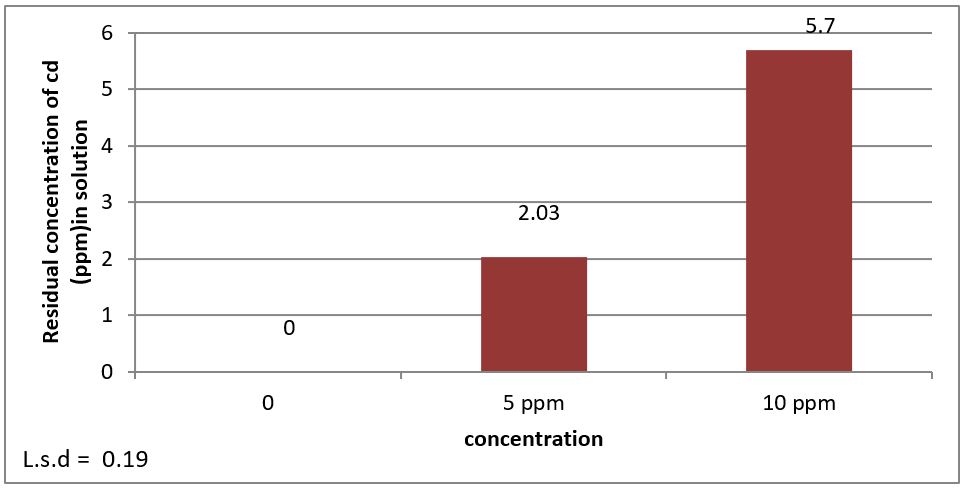
Copper and cadmium pollution in water is a serious environmental problem because of toxic effects on living organisms and ecosystems, Phytoremediation using aquatic plants is a novel, efficient and low-cost technique for improving wastewater and water quality. The aim of this study was to evaluate the efficiency of Ceratophyllum demersum as an ecological solution for the treatment of copper and cadmium contaminated water. To investigate the ability of Ceratophyllum demersum to absorb and remove the heavy metals copper (Cu) and cadmium (Cd) from wastewater and reduce their concentrations to environmentally safe level. The absorption capacity of the plant was studied through a laboratory experiment with different copper and cadmium concentrations (0, 5 and 10 ppm). The residual concentrations of copper and cadmium in the water after treatment were determined by Inductively Coupled Plasma-Optical Emission Spectrometry (ICP-OES) and removal efficiency and chlorophyll content in the plant were also measured. The results show that the highest removal efficiency was Cu (64.54%) and Cd (59.4%) at 5 ppm, and it decreased to Cu (47.4%) and Cd (43%) at 10 ppm. There was a decrease in chlorophyll content with increase in copper and cadmium concentrations which was 2.16mg/g for Cu and 1.5mg/g for Cd in the non-exposed group, at 5 ppm it was decreased to Cu (2.01mg/g) and Cd (1mg/g) but at 10 ppm it was Cu (1.09mg/g) and Cd (0.9mg/g) respectively. The results indicated that Ceratophyllum demersum was efficient in removing copper and cadmium from water but the efficiency was affected by metal concentration.
Metrics
References
Aasim, M., Ali, S. A., Aydin, S., Bakhsh, A., Sogukpinar, C., Karatas, M., Khawar, K. M., and Aydin, M. E. (2023). Artificial intelligence-based approaches to evaluate and optimize phytoremediation potential of in vitro regenerated aquatic macrophyte Ceratophyllum demersum L. Environ. Sci. Pollut. Res., 30, 12232–12245.
Abdulwahid, K. D. (2023). Phytoremediation of cadmium pollutants in wastewater by using Ceratophyllum demersum L. as an aquatic macrophyte. Water Conserv. Manag., 7(2), 83–88.
Arnon, D. I. (1949). Copper enzymes in isolated chloroplasts. Polyphenoloxidase in Beta vulgaris. Plant Physiol., 24(1), 1–15.
Ashraf, S., Ali, Q., Zahir, Z. A., Ashraf, S., and Asghar, H. N. (2019). Phytoremediation: Environmentally sustainable way for reclamation of heavy metal polluted soils. Ecotoxicol. Environ. Saf., 174, 714–727. https://doi.org/10.1016/j.ecoenv.2019.02.068
Bailey, S. E., Olin, T. J., Bricka, R. M., and Adrian, D. D. (1999). A review of potentially low-cost sorbents for heavy metals. Water Res., 33(11), 2469–2479.
Bhat, F. A., and Meril, D. (2022). Dynamic landscape of ichthyofaunal diversity in India: Discoveries and exploration (2009–2022).
Dushenkov, V., Kumar, P. B. A. N., Motto, H., and Raskin, I. (1995). Rhizofiltration: The use of plants to remove heavy metals from aqueous streams. Environ. Sci. Technol., 29(5), 1239–1245.
El-Khodary, S. A., and Al-Homaid, A. (2021). Phytoremediation potential of Ceratophyllum demersum for copper removal from contaminated water. Egypt. J. Aquat. Biol. Fish., 25(4), 167–182.
Fu, F., and Wang, Q. (2011). Removal of heavy metals from wastewaters: A review. J. Environ. Manage., 92(3), 407–418.
Ghosh, M., and Singh, S. P. (2005). A review on phytoremediation of heavy metals and utilization of its byproducts. Appl. Ecol. Environ. Res., 3(1), 1–18.
Liao, Q., and Zhang, T. (2019). Efficiency of Ceratophyllum demersum in the removal of copper from contaminated aquatic ecosystems. Environ. Toxicol. Chem., 38(5), 1032–1040.
Mishra, V. K., and Tripathi, B. D. (2008). Concurrent removal and accumulation of heavy metals by three aquatic macrophytes. Bioresour. Technol., 99(15), 7091–7097.
Ostroumov, S. A., and Shestakova, T. V. (2009). Decreasing the measurable concentrations of Cu, Zn, Cd, and Pb in the water of the experimental systems containing Ceratophyllum demersum: The phytoremediation potential. Dokl. Biol. Sci., 428, 444–447.
Polechońska, L., Klink, A., Dambiec, M., and Rudecki, A. (2018). Evaluation of Ceratophyllum demersum as the accumulative bioindicator for trace metals. Ecological Indicators, 93, 274-281.
Rajeshkumar, S., and Li, X. (2018). Bioaccumulation of heavy metals in fish species from the Meiliang Bay, Taihu Lake, China. Toxicol. Rep., 5, 288–295.
Ranjan, R., Singh, S. P., and Yadav, A. K. (2020). Copper accumulation and detoxification mechanisms in aquatic plants: A review on phytoremediation of copper by Ceratophyllum species. Sci. Total Environ., 740, 139913.
Salt, D. E., Smith, R. D., and Raskin, I. (1998). Phytoremediation. Annu. Rev. Plant Physiol. Plant Mol. Biol., 49, 643–668.
Xie, S. S., Zhang, C., and Wu, Q. L. (2021). Role of Ceratophyllum demersum in phytoremediation of copper from contaminated water. Sci. Total Environ., 760, 143322.
Zeng, X., Xu, Y., Boeckx, P., and Wang, C. (2017). Influence of pH on copper uptake and accumulation in wetland plants: A case study with Typha latifolia. Chemosphere, 180, 196–203.
Downloads
Published
How to Cite
Issue
Section
License
Copyright (c) 2026 Iraqi Journal of Aquaculture

This work is licensed under a Creative Commons Attribution 4.0 International License.